Customs duties are the responsibility of customers, but standard logistics support DDP to most countries, duty-free such as US, DE, UK, CA, FR, IT, PL, AT, JP…



Introduction
With the rapid growth of cloud computing, 5G, and AI services, data centers require higher-density, higher-speed, and more reliable fiber cabling solutions. MPO (Multi-fiber Push-On) fiber connectors have become the industry standard for 40G, 100G, and 400G parallel optical transmission.
This article fully explains MPO fiber connectors based on EIA/TIA-604-5 (FOCIS 5) and IEC-61754-7 international standards, including core counts, male/female gender, three standardized polarity types, pre-terminated system advantages, and real-world applications. All information is verified against professional fiber optic cabling specifications.
What Is an MPO Fiber Connector?
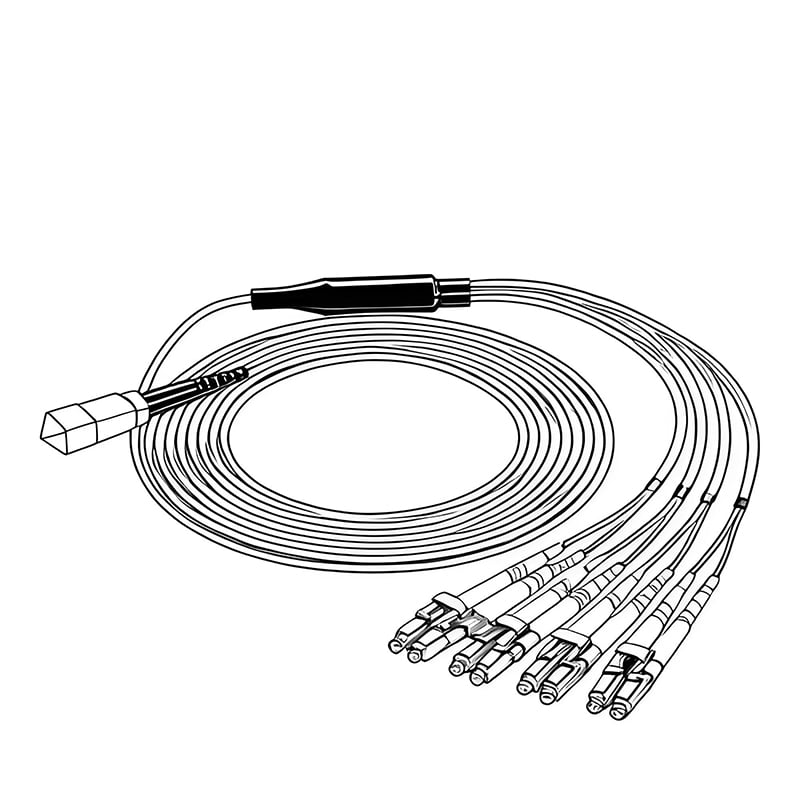
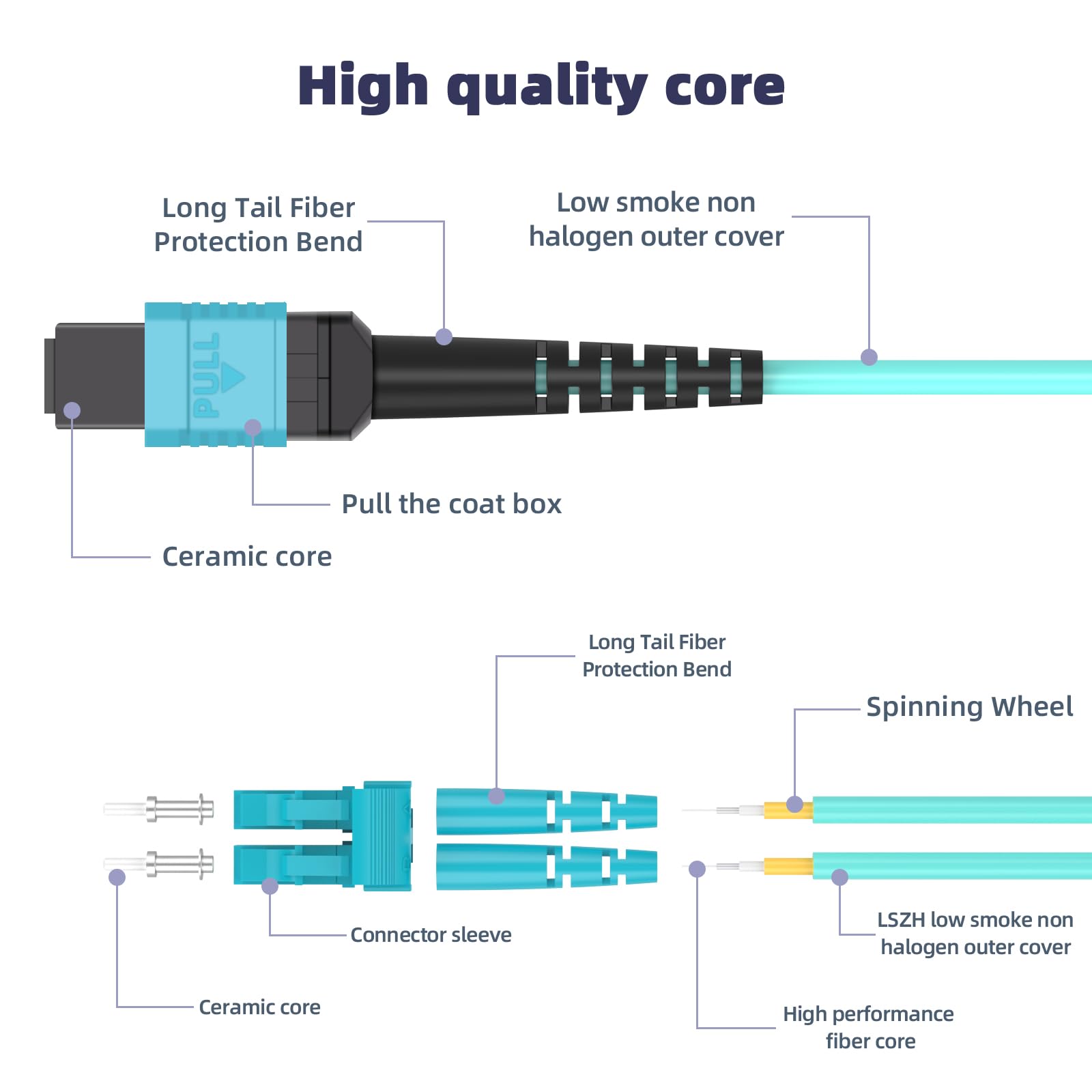
MPO is a multi-fiber optical connector designed exclusively for high-density cabling environments. It integrates multiple optical fibers into a single compact ferrule, supporting fast push-on plug-and-play connections without special tools.
MPO connectors are widely used in three primary areas:
- High-density data center cabling
- Fiber-to-the-Building (FTTB) access networks
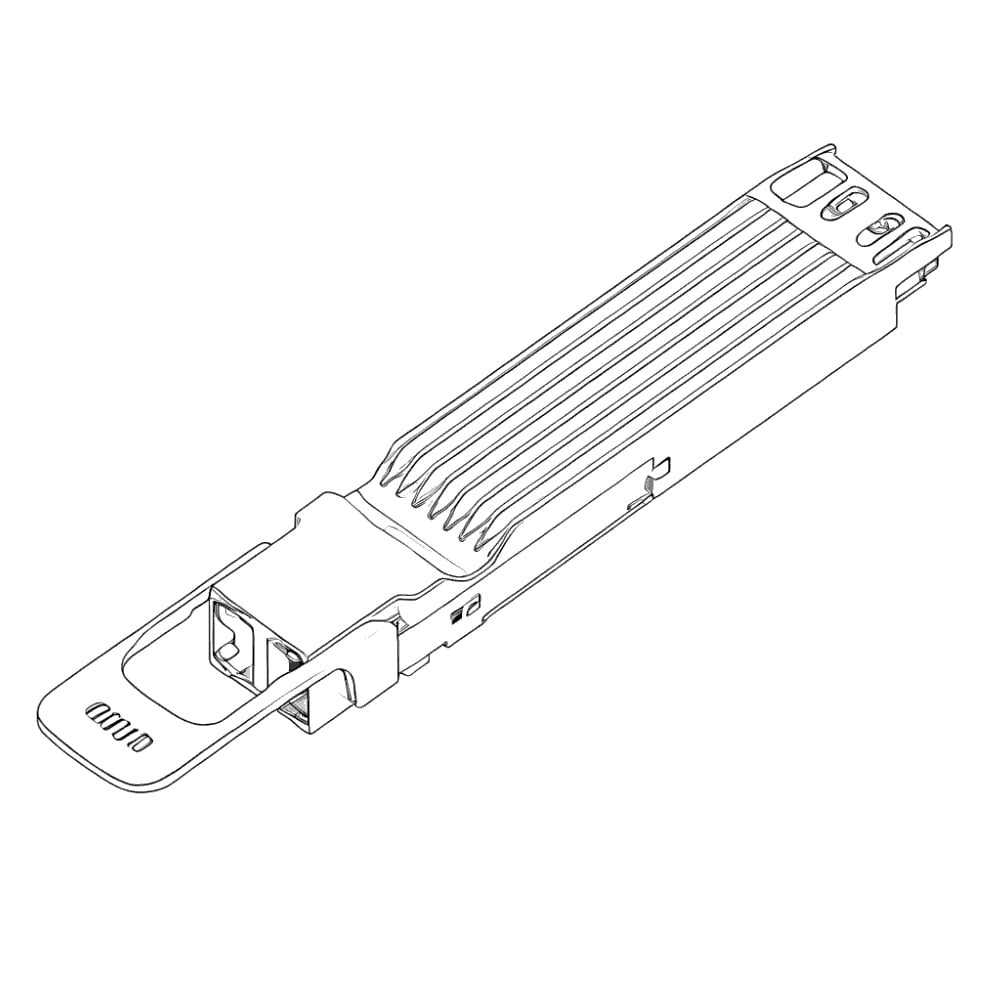
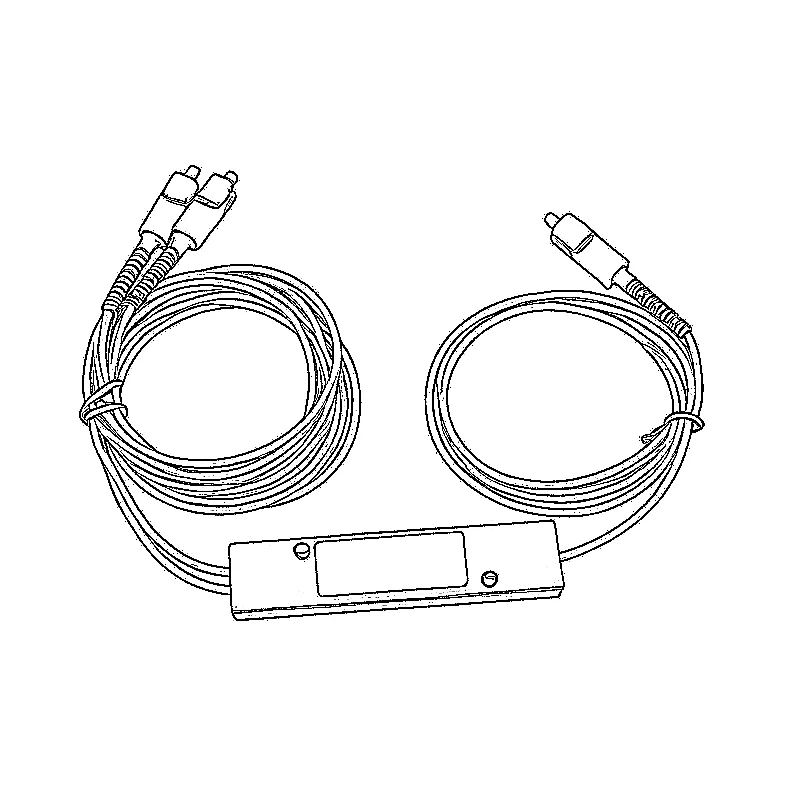
- Internal connections for optical splitters and 40G/100G SFP+/QSFP transceivers
All qualified MPO pre-terminated products are factory-assembled and 100% optically tested to ensure consistent performance and reliability.
Common MPO Fiber Core Counts (Standardized)
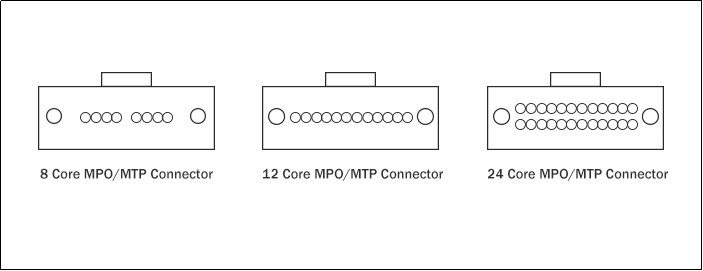
MPO connectors use a 12-fiber single row as the basic structural unit, which can be expanded into multiple rows. The following core counts are industry-standard:
- 8-core: The most common for 40G QSFP+ SR4 and 100G QSFP28 SR4 transceivers (4 transmit + 4 receive fibers)
- 12-core: The most widely used for general 40G MPO-MPO links and daily data center patching
- 24-core: Used for 100G short-distance transmission and rack-to-rack backbone cabling
- 16/32-core: Next-generation design for 400G low-latency ultra-high-speed networks
MPO Connector: Male vs Female (Critical Mating Rule)
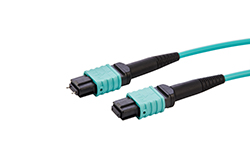
MPO connectors are strictly divided into male and female genders, which must be used in male-to-female pairs only. Any other combination will cause connection failure or permanent physical damage to the connectors.
| Item | Male MPO Connector | Female MPO Connector |
|---|---|---|
| Defining Feature | Equipped with two precision guide pins on the ferrule | No guide pins, only matching alignment holes |
| Alignment Role | Provides exact fiber positioning during mating | Accepts guide pins for stable, low-loss connection |
| Typical Applications | Trunk cables, backbone links, patch panel ports | Patch cords, optical transceivers, equipment-side connections |
| Compliance | EIA/TIA-604-5, IEC-61754-7 | EIA/TIA-604-5, IEC-61754-7 |
MPO Polarity Types: Type A, Type B, Type C (Standardized)
Polarity ensures that transmit (Tx) fibers correctly connect to receive (Rx) fibers. There are three internationally standardized polarity types for MPO cables:
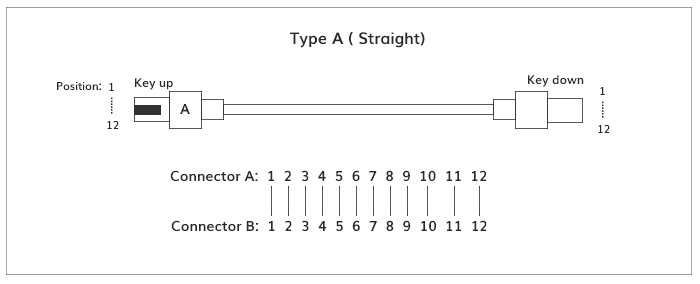
1. Type A (Straight-Through)
- Fiber mapping: 1→1, 2→2, …, 12→12 (identical sequence at both ends)
- Key direction: Key Up ↔ Key Down (opposite orientations)
- Best for: Simple point-to-point direct connections, server-to-TOR switch links
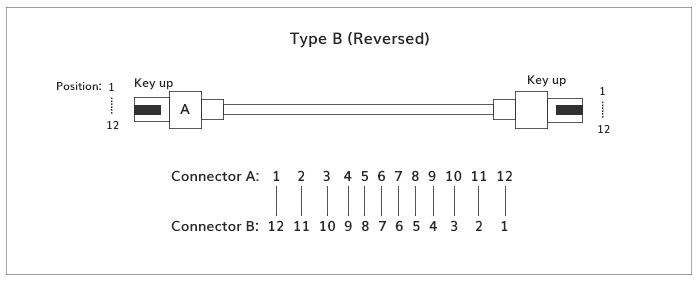
2. Type B (Full Reversed / Crossed)
- Fiber mapping: 1→12, 2→11, …, 12→1 (complete reverse sequence)
- Key direction: Key Up ↔ Key Up (same orientation at both ends)
- Best for: Backbone cross-connects, equipment with internal signal flipping, 40G/100G SR4 transceivers
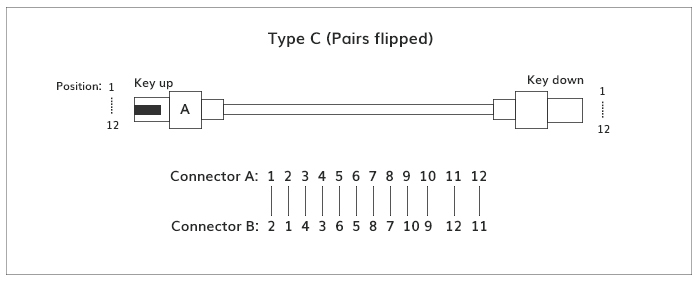
3. Type C (Pairwise Flipped)
- Fiber mapping: 1↔2, 3↔4, …, 11↔12 (adjacent fiber pairs swapped)
- Key direction: Key Up ↔ Key Down (opposite orientations)
- Best for: Duplex transmission systems and paired signaling applications
4 Verified Benefits of Pre-Terminated MPO Cabling Systems
All benefits below are confirmed by real-world data center deployment experience:
- Guaranteed Performance & FlexibilityFactory pre-terminated and 100% tested, eliminating field termination errors. Supports seamless network expansion and future speed upgrades.
- Ultra-High Density Saves SpaceModular compact design reduces cable and port footprint by up to 70% compared to traditional single-fiber connectors, enabling higher-density wiring in limited cabinet space.
- Fast Deployment & Lower Labor CostPlug-and-play installation requires no on-site splicing or special tools. Cuts installation time and labor costs by up to 70% compared to field-terminated cabling.
- Optimized for High-Speed NetworksSpecifically designed for parallel optical transmission, making it the only viable solution for 40G/100G/400G data center backbones.
Typical Applications of MPO Fiber Connectors
- Hyperscale & Enterprise Data Centers: Rack-to-rack, row-to-row, and main distribution area high-density cabling
- High-Speed Optical Transceivers: 40G QSFP+ SR4, 100G QSFP28 SR4, and other parallel optical modules
- FTTH & FTTB: Building fiber access and residential high-speed fiber cabling
- Optical Splitters & Integrated Cabling: Compact optical link integration scenarios
Quick MPO Selection Guide (100% Accurate)
- For 40G/100G QSFP+ SR4 / QSFP28 SR4 transceivers → Use 8-core Type B (crossed) MPO cables
- For standard data center patching and 40G MPO-MPO links → Use 12-core Type A MPO cables
- For backbone cross-connections and 100G short-distance transmission → Use 24-core Type B MPO cables
- For 400G low-latency networks → Use 16/32-core MPO connectors
- Always verify: male ↔ female mating + correct polarity before deployment
Frequently Asked Questions (Short & Authoritative)
Q1: Can I connect two male or two female MPO connectors together?
A: No. MPO connectors require one male and one female to mate properly. Male-to-male or female-to-female connections will damage the ferrules and cause permanent signal loss.
Q2: Which MPO polarity should I use for 100G SR4 transceivers?
A: Use 8-core Type B (full reversed) MPO cables. This is the industry standard for all 40G and 100G SR4 parallel optical modules.
Q3: What is the maximum number of fibers an MPO connector can support?
A: Standard MPO connectors support 6 to 144 fibers. The most common sizes are 8, 12, and 24 cores for modern data center applications.
Q4: Are pre-terminated MPO cables better than field-terminated ones?
A: Yes. Pre-terminated MPO cables are 100% factory tested, deliver more consistent performance, install 70% faster, and have lower long-term failure rates than field-terminated cables.
Q5: What is the difference between 12-core and 24-core MPO cables?
A: 12-core MPO cables use a single row of fibers and are ideal for general patching. 24-core MPO cables use two rows of fibers and are designed for high-capacity backbone cabling and 100G transmission.
Conclusion
MPO fiber connectors are the foundational component of modern high-density, high-speed data center cabling. Understanding core counts, male/female gender requirements, and the three standardized polarity types is essential for building stable and efficient 40G/100G/400G networks.
With factory pre-termination, full international standards compliance, and excellent scalability, MPO systems provide the reliability, density, and cost efficiency required for today’s and tomorrow’s data centers.
Direct shipment from our fiber factory, Customize MPO Cable:
MTP/MPO Fiber Cables Archives – LuLeey.com | One-stop Optical Fiber Product Supplier
Fiber Optic Loopback Archives – LuLeey.com | One-stop Optical Fiber Product Supplier
 SFP/SFP+ (1G/2.5G/5G/10G)
 SFP-T (1G/2.5G/10G)
 AOC Cable 10G/25G/40G/100G
 DAC Cable 10G/25G/40G/100G
 QSFP28 QSFP+ SFP28 100G/40G/25G
 Copper to Fiber Media Converters
 Fiber Media Converter PCBA Board
 OEO Fiber Media Converters
 Serial to Fiber Media Converters
 Video to Fiber Media Converters
 1000M GPON/EPON ONU
 10G EPON ONU/XG-PON/XGS-PON
 2.5G GPON/XPON STICK SFP ONU
 POE GPON/EPON ONU
 Wireless GPON/EPON ONT
 EPON OLT
 GPON OLT
 SFP PON Module
 Industrial Switches
 Managed Switches
 POE Switches
 Unmanaged Switches
 MTP/MPO Fiber Cables
 Fiber Optic Cassettes
 Fiber Optic Loopback
 Optic Cables and Fiber Pigtails
 Optical Splitters and Splitter Box
 Fiber Flange Connectors
 Optical Adapters
 Optical Attenuator
 Quick Connector and Connector Panel
 CATV Amplifier
 CATV Optical Receiver
 Visual Fault Locator
 OTDR
OTDR Optical Power Meter
 Fiber Optic Identifier
 Fiber Optic Cleaners
 Fiber Cleavers & Fiber Strippers
 Copper Tools


