Os impostos alfandegários são de responsabilidade dos clientes, mas a logística padrão oferece suporte ao DDP para a maioria dos países, com isenção de impostos, como EUA, Alemanha, Reino Unido, Canadá, França, Itália, Portugal, Áustria, Japão...

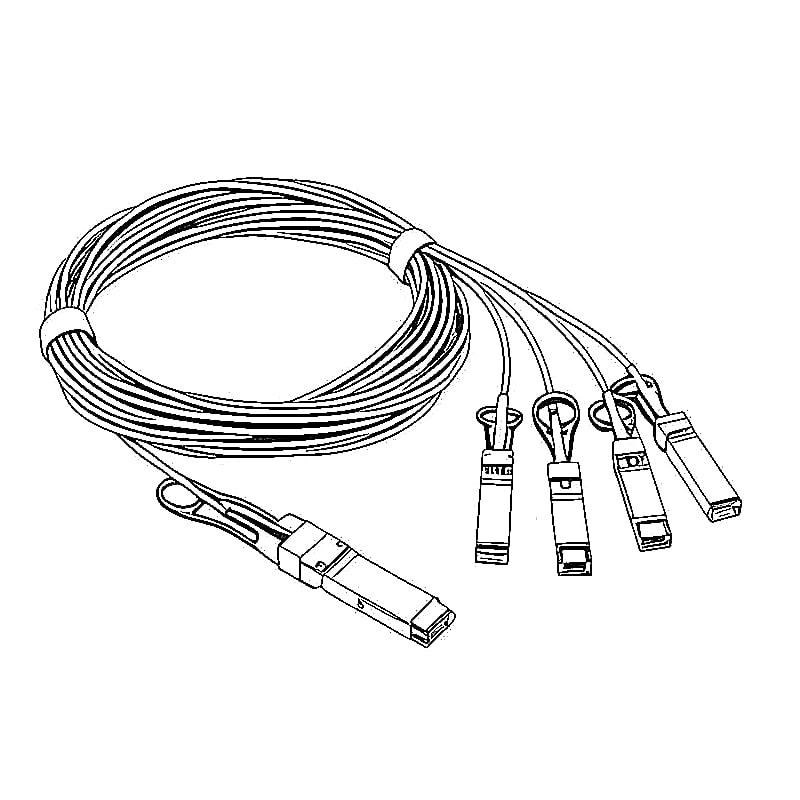
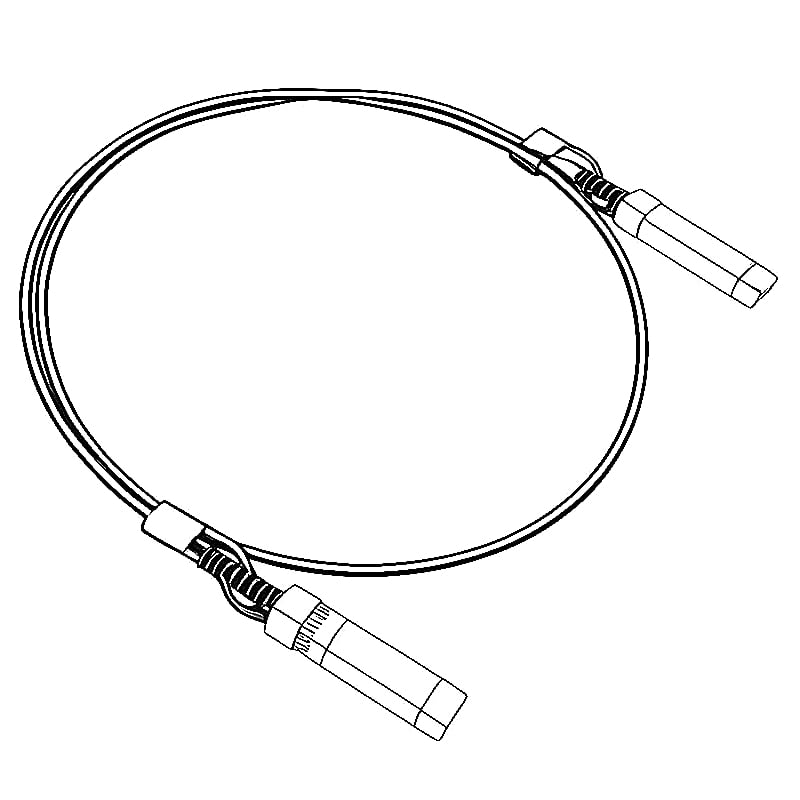
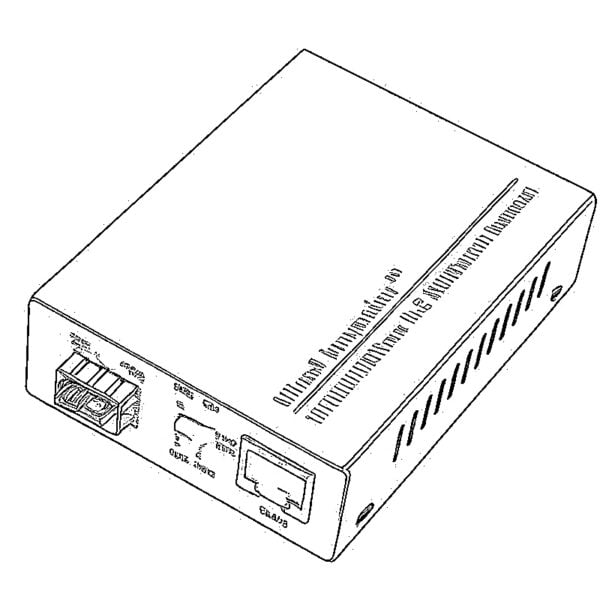
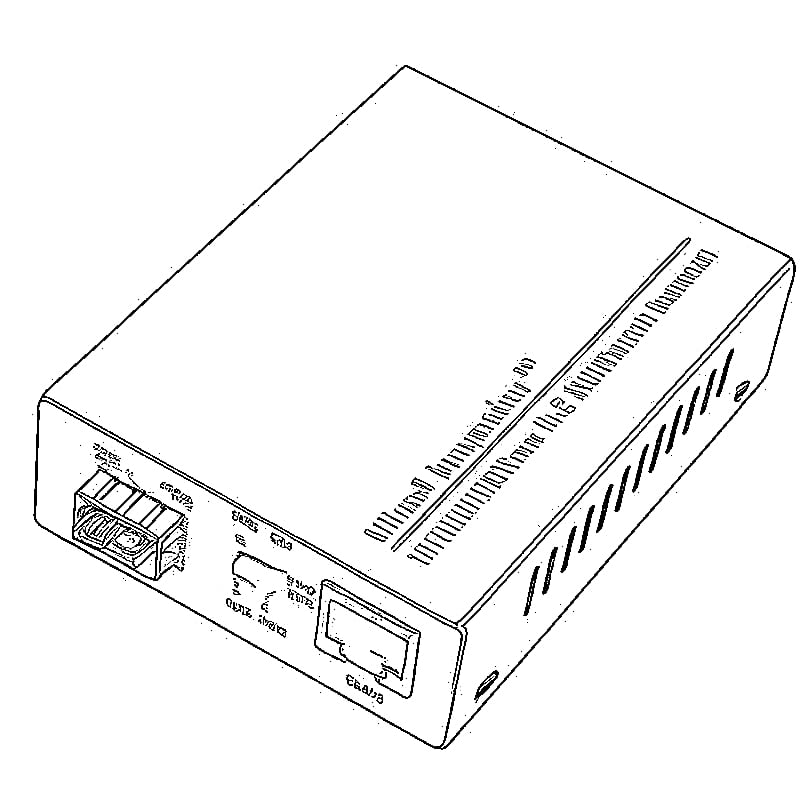


Solução de problemas 10GbE slow file transfers starts with separating three numbers: the port’s link speed, the throughput between two computers, and the speed of the file copy itself.
A 10G link indicator confirms a link rate—not a guaranteed NAS transfer speed. Before replacing an SFP+ module, run a local network test between the same endpoints used for the slow copy. Then compare the results with a controlled file transfer.
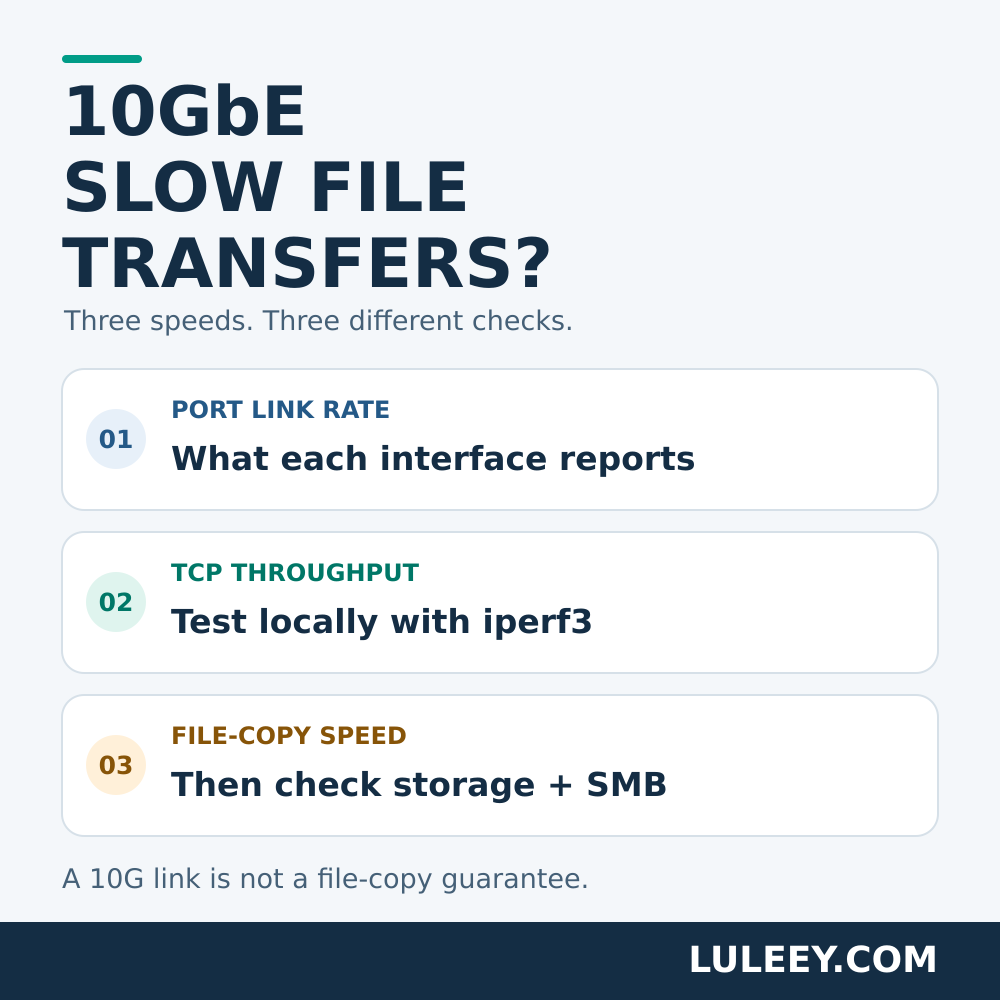
10GbE Slow File Transfers: Check the Units First
Network speeds are usually shown in Gbps ou Mbits/sec. File-copy tools commonly show MB/s ou MiB/s.
Using decimal units:
- 10 Gbps ÷ 8 = 1.25 GB/s before protocol overhead.
- 100 MB/s × 8 = 800 Mbps.
Neither number is a diagnosis. A 100 MB/s copy could be constrained by a slower network segment, storage or the application. Also check whether the copy tool uses MiB/s rather than decimal MB/s.
1. Confirm Which Network Path You Are Testing
Write down the path from client to NAS, including every intermediate switch, converter and uplink. Check the actual operating rate at each relevant interface—not just the adapter’s advertised capability.
Use the NAS address assigned to the intended wired interface. A hostname may lead to a different interface. Confirm that the transfer is not taking Wi-Fi, a VPN, a management port or an unexpected routed path.
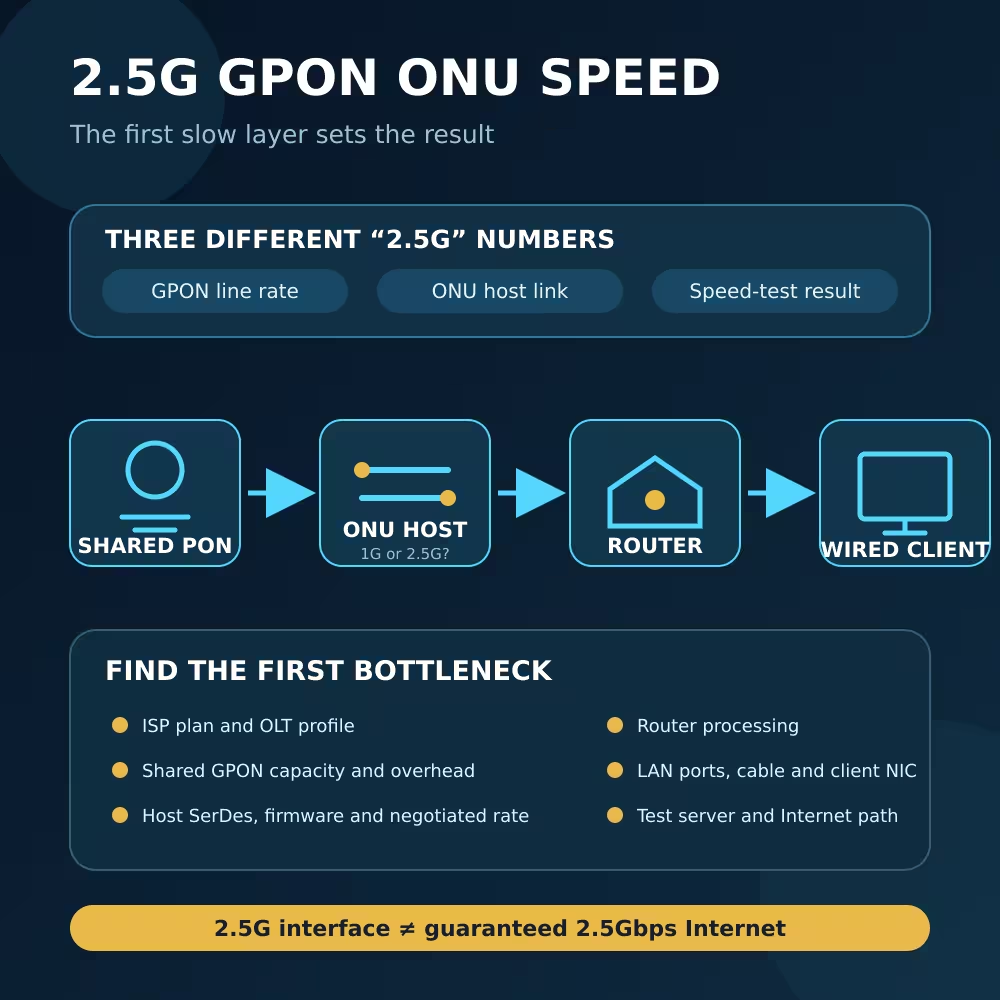
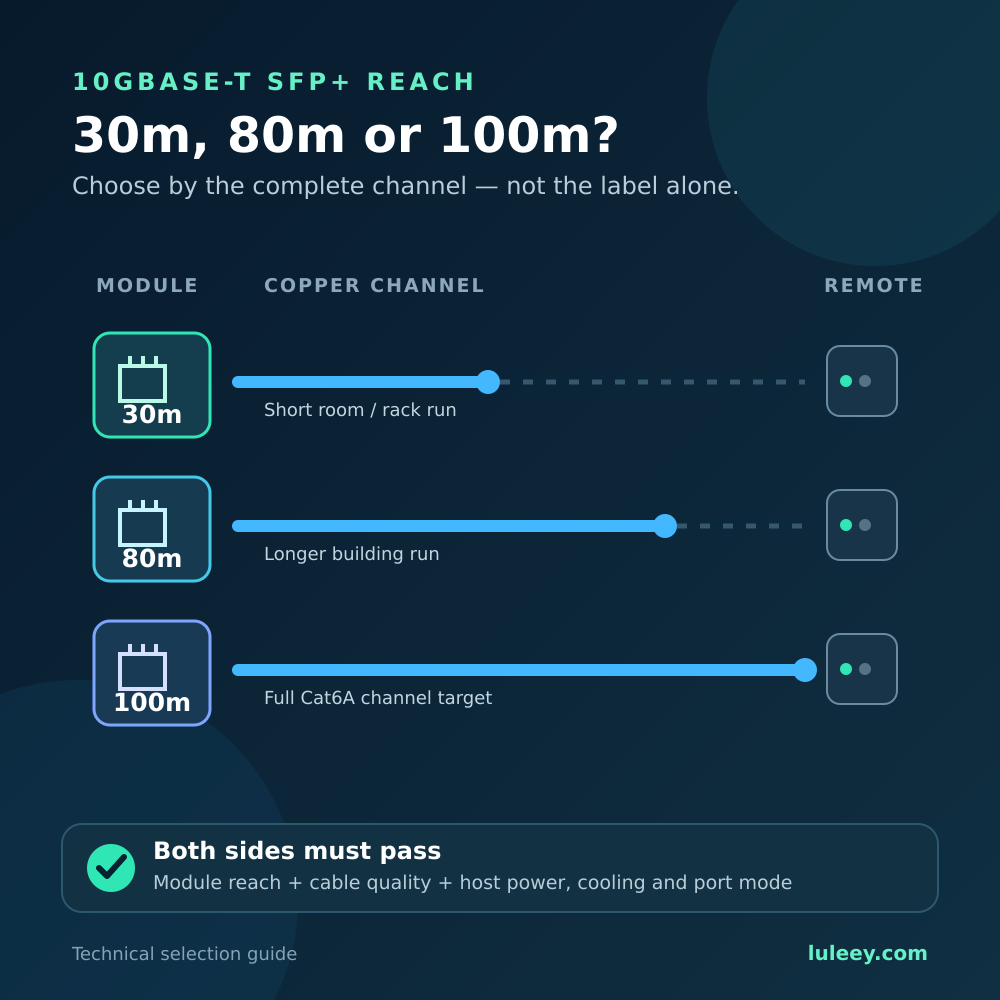
For a copper SFP+ module, the host-facing electrical rate and RJ45 negotiation can differ. A supported rate-adaptive combination may show 10G at the host while its copper peer operates at 2.5G. See LuLeey’s guide to connecting a 10G SFP+ port to 2.5G RJ45.
Physical fit, host SerDes mode, negotiated rates and usable throughput are separate checks. Record the exact host and module models, host chipset/PHY, firmware, driver, port settings and module coding before drawing compatibility conclusions. A cage marked SFP+ does not settle them.
2. Run a Local Network Test Without Copying Files
Use two authorized machines on the affected path. Ideally, run the server on the NAS itself; a different server only tests the path to that server. Do not test against localhost or an Internet speed-test site.
These commands assume a trusted, compatible iperf3 installation. ESnet does not officially support iperf3 on Windows; verify any Windows build separately, or use a supported platform. A VM or container introduces another path to document. See the ESnet compatibility FAQ.
For this example, the server’s LAN address is 192.168.10.20. Replace it with your actual address. Test during a quiet period: throughput tests can congest the network. Permit TCP 5201 only between the test machines; do not expose the server to the Internet.
On the server:
iperf3 -s -B 192.168.10.20On the client, run these separately:
iperf3 -c 192.168.10.20 -t 30
iperf3 -c 192.168.10.20 -t 30 -R
The first sends client → server. -R sends server → client. These are consecutive tests, not simultaneous bidirectional traffic.
If a single stream is slow, compare four streams:
iperf3 -c 192.168.10.20 -t 30 -P 4
iperf3 -c 192.168.10.20 -t 30 -P 4 -R
Save the final receiver summary; for parallel tests, use the aggregate [SUM] result. Record CPU use, retransmissions where reported, and interface-counter changes. Stop the server with Ctrl+C afterward. Command behavior is documented in the official iperf3 manual.
Ordinary tests generate traffic without reading your source file or writing a destination file. They still depend on the endpoints, software and network path—not just the cable.

3. Let the Results Choose the Next Check
The patterns below are diagnostic clues, not universal pass/fail thresholds.
| O que você observa | Useful next step |
|---|---|
| TCP tests are much faster than the file copy in the same direction | Investigate storage and file-sharing workload first; confirm both tests use the same path. |
| Both directions are slow | Recheck every link rate, endpoint CPU, NIC/driver and intermediate device. |
| Only one direction is slow | Compare sending and receiving endpoints, errors, drops and any rate-adaptation boundary. |
| Four streams substantially outperform one | Investigate per-flow or endpoint limits; do not treat aggregate speed as a single-file guarantee. |
| Performance worsens as errors or link events rise | Isolate the affected physical segment and repeat under the same conditions. |
Record the iperf3 version at both ends. Older advice describing all iperf3 tests as single-threaded is version-dependent: ESnet documents one thread per stream from version 3.16 onward. That does not mean four streams will always help.
Do not change MTU, flow control, drivers and modules together. Keep a known-working baseline, make one justified change, and repeat the same test.
4. Compare a Controlled File Copy
If TCP performance is good, copy one large, ordinary file into a dedicated test folder without overwriting existing data. Check both directions. Then compare a folder of small files.
Watch source read speed, destination write speed and CPU use. A fast opening burst followed by a slowdown can reflect exhausted caches. Many small files add repeated metadata operations. SMB signing and encryption can add CPU work; keep required security protections enabled.
Microsoft’s SMB troubleshooting guidance explains these storage, caching and workload effects. They are reasons to investigate the file-copy path—not proof that your particular NAS has a disk fault.
For example, a hypothetical result of 9 Gbps in a same-direction TCP test and 220 MB/s in a file copy shifts the next check toward storage and file sharing. It does not certify every network condition or identify one failed component.
5. Investigate Modules When the Evidence Points There
If network tests are also poor, compare interface counters before and after each run. Increasing CRC/FCS errors justify checking the relevant physical link; drops without CRC errors can have other causes, including congestion. A TCP retransmission count alone does not identify a bad module.
For copper links, substitute a known-good cable within the selected module’s documented reach. For optical links, verify the fiber type, matched transceivers, connector condition and model-specific receive-power limits. Inspect and clean with appropriate tools; never look into a fiber or optical port.
Also check host power and cooling requirements. If the interface repeatedly goes down and up, follow the separate 10GBASE-T SFP+ link-flapping checklist.
Swap one component at a time. Repeat in the original setup if safe: a result that follows a particular component is more useful than a one-off improvement after several changes.
Before Buying a Different Module
LuLeey’s Solução de atualização do HomeLab para 10G covers copper, DAC/AOC and optical connection options. Its 10GBASE-T SFP+ to RJ45 module page offers multiple variants; confirm the selected hardware, supported modes and reach against your actual setup. Do not assume every option behaves identically.
For useful compatibility advice, send LuLeey:
- Both endpoint models, host chipset/PHY, firmware and drivers
- Module variant, coding, host mode and port settings
- Cable type, length and complete connection path
- Observed rates on both sides of any converter or copper module
- Forward/reverse TCP results, CPU use and counter changes
- File-copy direction, speed, workload and storage observations
Start with the comparison, not the replacement: confirm the path, test TCP in both directions, then compare file copies. This tells you where the next test belongs.
 SFP/SFP+ (1G/2,5G/5G/10G)
 SFP-T (1G/2,5G/10G)
 Cabo AOC 10G/25G/40G/100G
 Cabo DAC 10G/25G/40G/100G
 QSFP28 QSFP+ SFP28 100G/40G/25G
 Conversores de mídia de cobre para fibra
 Placa PCBA do conversor de mídia de fibra
 Conversores de mídia de fibra OEO
 Conversores de mídia serial para fibra
 Conversores de mídia de vídeo para fibra
 1000M GPON/EPON ONU
 10G EPON ONU/XG-PON/XGS-PON
 2,5G GPON/XPON STICK SFP ONU
 POE GPON/EPON ONU
 ONT GPON/EPON sem fio
 EPON OLT
 GPON OLT
 Módulo SFP PON
 Switches industriais
 Switches gerenciados
 Switches POE
 Switches não gerenciados
 Cabos de fibra MTP/MPO
 Cassetes de fibra óptica
 Loopback de fibra óptica
 Cabos ópticos e pigtails de fibra
 Divisores ópticos e caixas divisoras
 Conectores de flange de fibra
 Adaptadores ópticos
 Atenuador óptico
 Conector rápido e painel de conectores
 Amplificador CATV
 Receptor óptico CATV
 Localizador visual de falhas
 OTDR
OTDR Medidor de potência óptica
 Identificador de fibra óptica
 Limpadores de fibra óptica
 Cortadores de fibras e extratores de fibras
 Ferramentas de cobre


