Customs duties are the responsibility of customers, but standard logistics support DDP to most countries, duty-free such as US, DE, UK, CA, FR, IT, PL, AT, JP…


No—not with an ordinary MPO mating adapter. Two female MPO Connectors both lack guide pins, so the adapter alone cannot provide the precision alignment required at the fiber end faces. The housings may latch, but that does not make the optical connection valid.
If you want to extend an existing cable, check the two ends that will actually meet. A female end needs a compatible pinned male end. Then verify the complete fiber mapping, fiber type and loss budget before putting the link back into service.

Why Two Female MPO Connectors Need More Than an Adapter
MPO Gender refers to the guide-pin arrangement:
- Male, or pinned: has two alignment pins.
- Female, or unpinned: has alignment holes but no protruding pins.
The adapter holds the connector housings together. The pins and holes align the ferrules. These are separate jobs; a standard empty adapter is not a gender converter. The FOA guide to MPO connections explains this division between housing retention and pin-based alignment.
The pins are mechanical alignment features—not electrical contacts and not transmit or receive channels.
| Ends meeting at one adapter | Gender check | Meaning |
| Female + female | Incorrect | Neither end supplies the alignment pins |
| Male + female | Correct gender pairing | Other compatibility checks are still required |
| Male + male | Incorrect | Opposing pins can interfere; do not force the connection |
This table addresses gender only. It does not certify the fiber layout, polish, key orientation or optical application.
Why Is a Female-to-Female MPO Cable Sold, Then?
“Female-to-female cable” describes the connectors at opposite ends of one cable. Those ends are not mated to each other.
For example, one end can connect to a verified pinned interface in Rack A, while the other connects to a verified pinned interface in Rack B. Each individual connection is still male-to-female.
Think of it as two separate questions:
- What connector is fitted to each end of the cable?
- What connector will each end meet in the installation?
A valid answer to the first question does not automatically answer the second.
LuLeey’s 12-fiber OM3 MPO trunk cable describes a female-to-female configuration and also lists male/female options for Connector A and Connector B. Check the selected options and order confirmation rather than relying on the URL or headline alone.
A Practical Extension Example
Suppose you have:
- Cable A: female-to-female, already running from Rack A.
- Cable B: another female-to-female cable intended to reach Rack B.
- A standard MPO adapter for the middle join.
- Equipment interfaces at both outer ends confirmed to be pinned male.
The outer connections may be correct, but the middle join would be female–adapter–female. That is the problem.
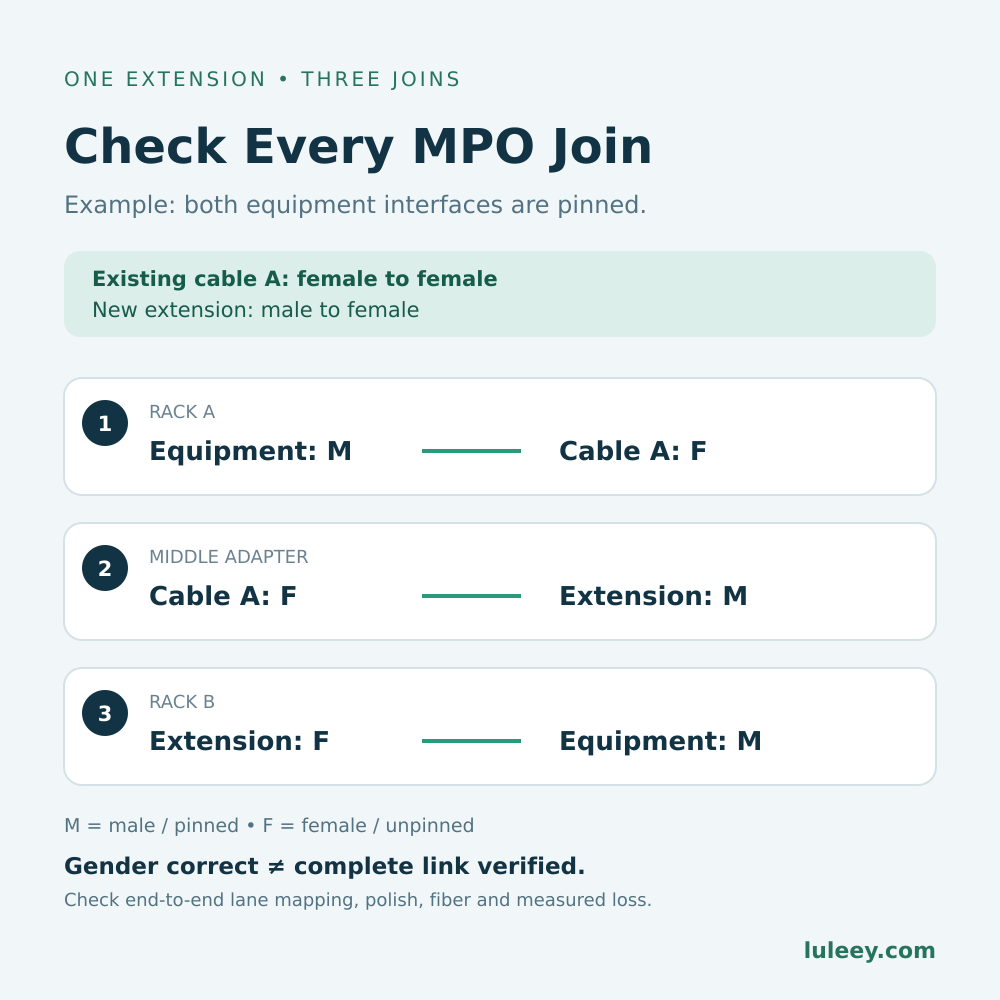
One possible correction is to retain Cable A and specify a male-to-female extension cable for Cable B. Put its male end at the middle join and its female end at the pinned Rack B interface.
The three mating locations then become:
| Location | First side | Second side |
| Rack A | Pinned equipment interface | Cable A female end |
| Middle adapter | Cable A female end | Extension male end |
| Rack B | Extension female end | Pinned equipment interface |
This is a gender-correct example, not a universal cable prescription. The replacement must also preserve the required end-to-end fiber mapping. Its polarity cannot be chosen from “male-to-female” alone.
If replacing the entire run is practical, one correctly specified longer cable also removes the middle mating connection and one potential contamination point.
Gender and Polarity Are Different Checks
Gender describes pins. Polarity describes which fiber position connects to which position at the far end.
Changing one connector from female to male does not, by itself, establish the correct optical lane mapping. Likewise, choosing a Type B cable does not add missing guide pins.
Before ordering an extension, give the supplier the complete route—including existing cables, adapters, cassettes and both endpoint part numbers. Ask for a position-by-position mapping, with the connector viewing orientation clearly stated.
For each required transmit lane, trace the route through every component to its intended receive lane. Do not assume that adding another cable with the same polarity label will preserve the original overall mapping.
LuLeey’s MTP/MPO cable selection guide provides the broader checklist for fiber type, count, connector options and cable length.
Can You Change an Existing Female Connector to Male?
Sometimes—but only when the exact connector design supports it and the manufacturer provides an approved procedure.
For example, US Conec documents field pin and polarity reconfiguration for its MTP PRO connector using the corresponding field tool. That is a feature of a specific connector system, not permission to modify every MPO cable. US Conec MTP PRO documentation
Do not push loose pins into an unidentified connector, pull pins out with pliers, or assume that every cable described as “MTP/MPO” uses MTP PRO hardware.
Ask the cable supplier to identify the connector series first. If an approved conversion is unavailable, order the appropriate assembly instead.
What to Check Before Reconnecting
Plan a maintenance window if the cable carries live traffic. Never look into a fiber or transceiver; use suitable inspection equipment and follow laser-safety procedures.
Then work through these checks:
- Identify the actual mating ends. Record their part numbers and pinned/unpinned status.
- Match the connector interface. Verify the MPO ferrule format, populated fiber positions and keying—not just the housing color.
- Match fiber and polish. Keep the specified single-mode or multimode fiber and compatible end-face polish. Do not directly mate flat-polished and angled-polished end faces.
- Inspect, clean if needed, then reinspect. Use an MPO-compatible probe and cleaner suitable for the connector’s pin arrangement.
- Check the complete lane map. Include the extension and middle adapter.
- Recalculate the channel loss. Added cable and mating connections consume some of the available optical budget; use the component specifications and measured results.
- Test the finished channel. Verify continuity, polarity and insertion loss on the required fibers, then check link behavior and error counters under traffic.
AFL’s connection instructions distinguish the two incorrect pairings: male-to-male can damage the end face, while female-to-female lacks adequate alignment. Neither should be used as a normal connection. AFL MPO cleaning and connection instructions
What to Send LuLeey Before Ordering
You do not need to know every connector term. Send a short description such as:
I have a female-to-female MPO cable that is too short. Both equipment interfaces are confirmed pinned. I need an extension with a male end at the middle join and a female end at the equipment. Please confirm the complete lane mapping and optical loss budget.
Also include the existing cable labels, endpoint part numbers, fiber type, populated fiber positions, polish and extra length needed. If photos are necessary, provide connector identification or properly obtained inspection images without looking into active optical ports.
Use LuLeey’s MTP/MPO fiber cable range to discuss the required configuration.
The important result is not simply a cable that clicks into place: it is correct mating at every join, correct routing for every required fiber, and acceptable measured loss.

 SFP/SFP+ (1G/2.5G/5G/10G)
 SFP-T (1G/2.5G/10G)
 AOC Cable 10G/25G/40G/100G
 DAC Cable 10G/25G/40G/100G
 QSFP28 QSFP+ SFP28 100G/40G/25G
 Copper to Fiber Media Converters
 Fiber Media Converter PCBA Board
 OEO Fiber Media Converters
 Serial to Fiber Media Converters
 Video to Fiber Media Converters
 1000M GPON/EPON ONU
 10G EPON ONU/XG-PON/XGS-PON
 2.5G GPON/XPON STICK SFP ONU
 POE GPON/EPON ONU
 Wireless GPON/EPON ONT
 EPON OLT
 GPON OLT
 SFP PON Module
 Industrial Switches
 Managed Switches
 POE Switches
 Unmanaged Switches
 MTP/MPO Fiber Cables
 Fiber Optic Cassettes
 Fiber Optic Loopback
 Optic Cables and Fiber Pigtails
 Optical Splitters and Splitter Box
 Fiber Flange Connectors
 Optical Adapters
 Optical Attenuator
 Quick Connector and Connector Panel
 CATV Amplifier
 CATV Optical Receiver
 Visual Fault Locator
 OTDR
OTDR Optical Power Meter
 Fiber Optic Identifier
 Fiber Optic Cleaners
 Fiber Cleavers & Fiber Strippers
 Copper Tools


