Customs duties are the responsibility of customers, but standard logistics support DDP to most countries, duty-free such as US, DE, UK, CA, FR, IT, PL, AT, JP…

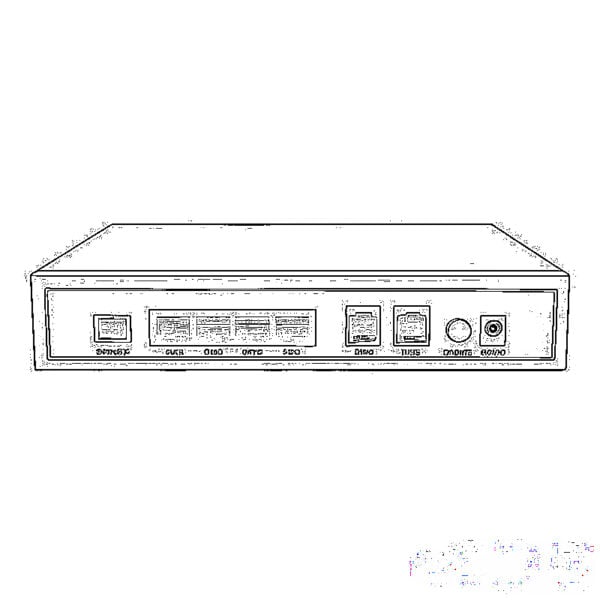

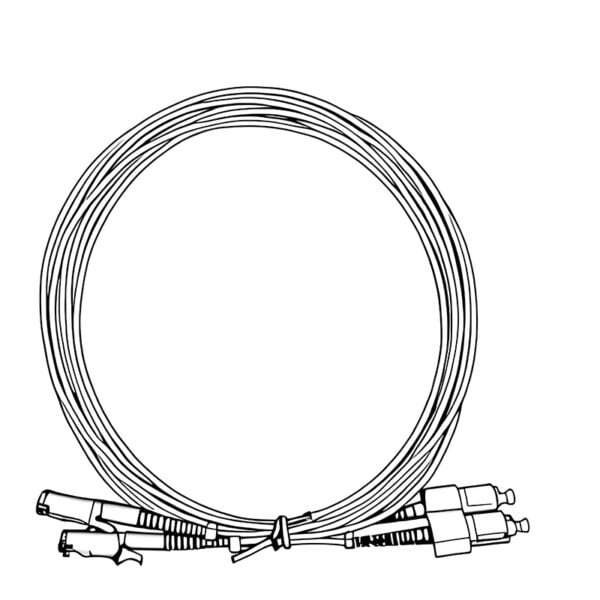
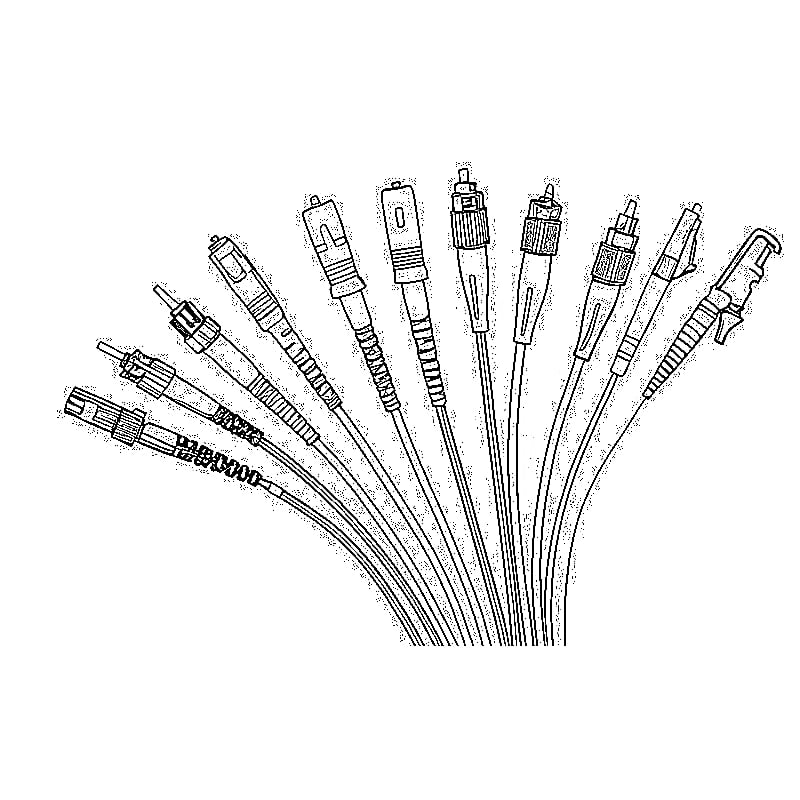
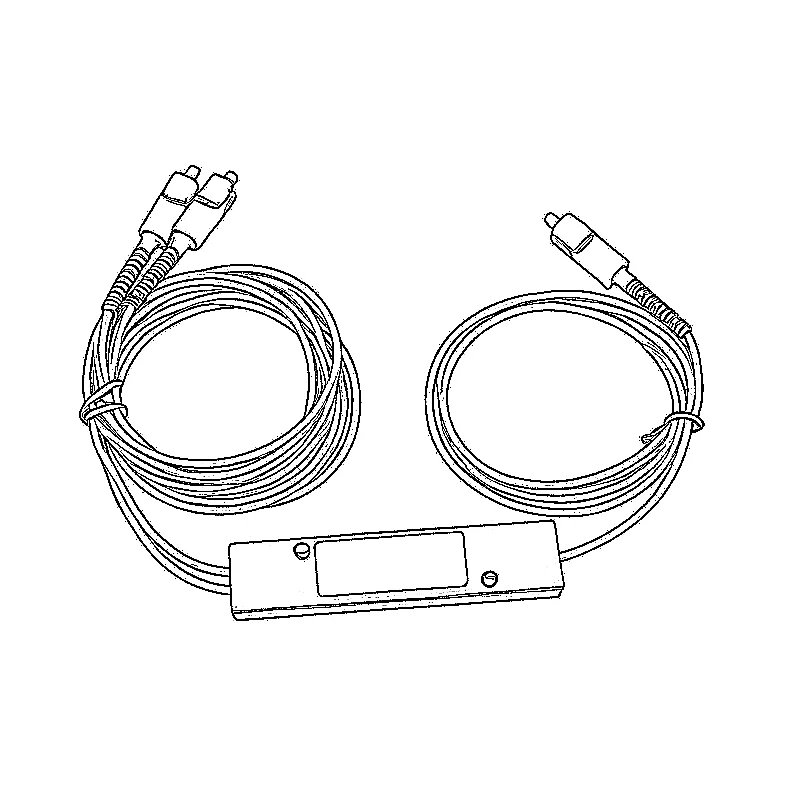
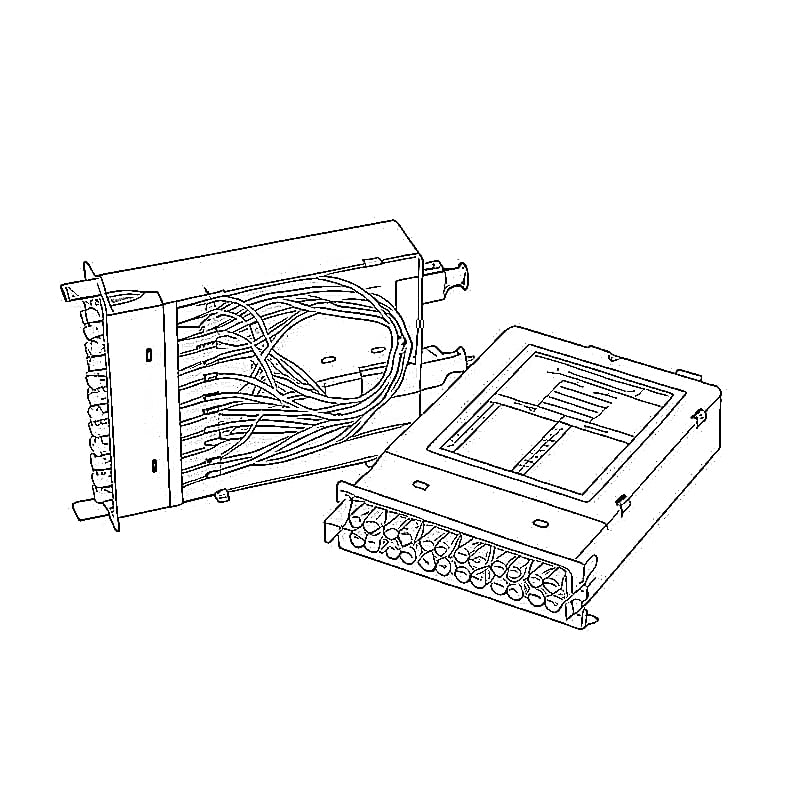

In many networks, you can reuse GPON splitters for xgs-pon, but only after verifying the exact passive component and recalculating the complete optical path. A splitter documented to operate across both PON wavelength bands may remain in service. An old part described only as a “GPON splitter” is not automatically proven suitable.
The splitter is also only one part of the answer. GPON and XGS-PON can share an Optical Distribution Network, or ODN, through a defined coexistence architecture. They do not become one interchangeable protocol. A GPON ONU still needs a GPON-capable OLT channel, while an XGS-PON ONU needs an XGS-PON-capable channel.
Before retaining the ODN, check its wavelength range, maximum insertion loss at the required wavelengths, split ratio, cascaded stages, connector polish, fiber condition and every additional passive device. Then compare the worst-case path loss with the exact OLT and ONU optical specifications in both directions.
Reuse GPON Splitters for XGS-PON: Quick Answer
| Existing condition | Can it be reused? | Required proof |
|---|---|---|
| PLC Splitter specified across the GPON and XGS-PON bands | Often yes | Datasheet, part number and worst-case loss across the required wavelengths |
| Splitter label shows only “GPON” with no wavelength data | Unknown | Retrieve the original specification or test a representative unit correctly |
| Legacy wavelength-selective or narrow-band passive device | Not automatically | Passband, isolation and insertion-loss verification |
| Existing 1:32 or 1:64 split | Possibly | New end-to-end budget for the exact XGS-PON optical class and route |
| Separate GPON and XGS-PON OLTs | Possible with the correct design | A standards-based coexistence element or another approved method |
| GPON/XGS-PON Combo OLT port | Designed for shared ODN use | Exact card, port, optics, firmware and supported ONU types |
| GPON ONU connected to an XGS-PON-only port | No normal registration | A GPON channel or Combo implementation is still required |
“Same fiber” means that the passive plant may be shared. It does not mean GPON and XGS-PON transceivers, framing, activation or provisioning are interchangeable.
Why GPON and XGS-PON Can Share One ODN
GPON and XGS-PON use separated wavelength plans:
| System | Nominal downstream rate | Nominal upstream rate | Typical downstream | Typical upstream |
|---|---|---|---|---|
| GPON | 2.48832 Gbit/s | 1.24416 Gbit/s | 1490nm | 1310nm |
| XGS-PON | 9.95328 Gbit/s | 9.95328 Gbit/s | 1577nm | 1270nm |
The exact spectral bands and optical requirements are defined in the applicable recommendations, not by these rounded center wavelengths alone. ITU-T G.984.2 specifies the GPON physical-media layer, while ITU-T G.9807.1 specifies XGS-PON.
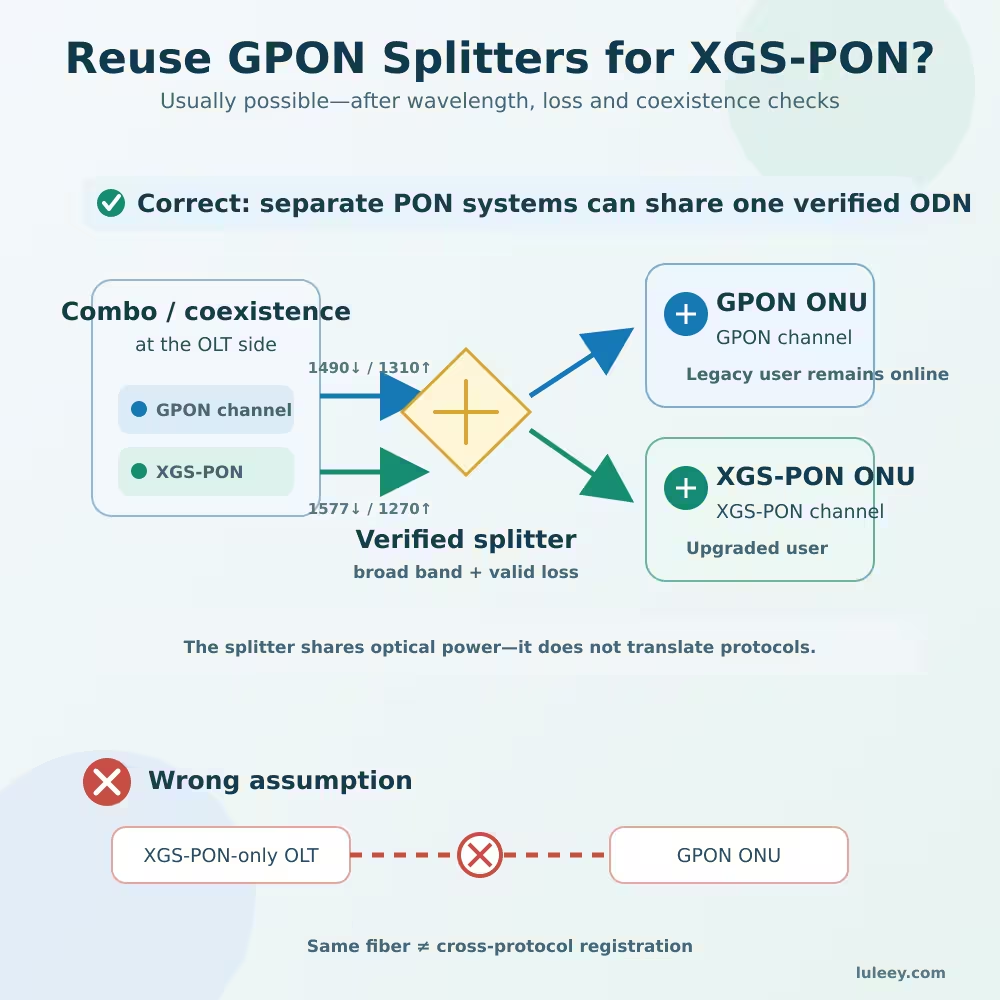
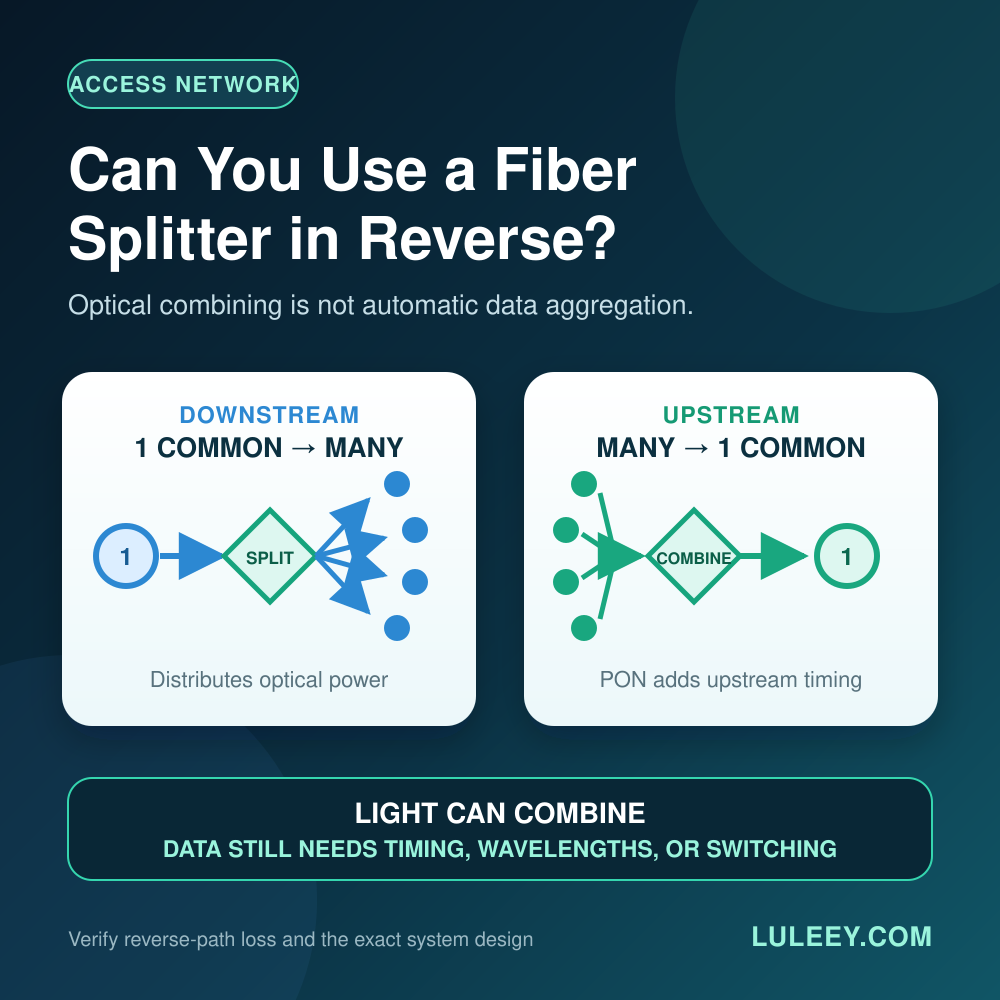
A broadband passive power splitter divides the optical power reaching its input. It does not need to understand GPON or XGS-PON frames. If the component performs within specification at all required wavelengths, the separated PON bands can pass through the same splitter and fibers.
At the central-office side, the systems still require the correct optical combining and separation. At each subscriber, the ONU receives the wavelength band intended for its own system. The distinct wavelengths enable coexistence; the splitter does not convert one PON generation into another.
A Shared Splitter Is Not a Shared Protocol
This distinction prevents a common purchasing mistake.
- A GPON ONU does not become an XGS-PON ONU because the fiber carries both wavelength sets.
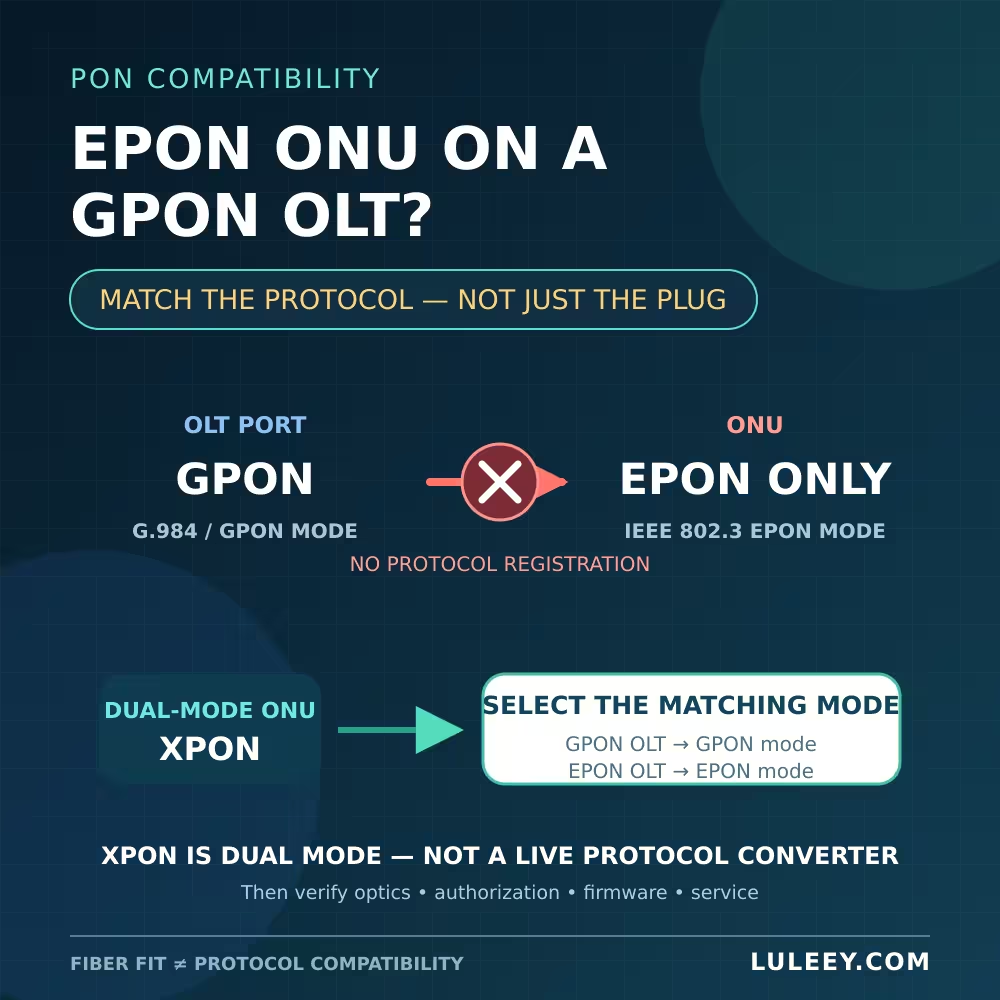
- An XGS-PON-only OLT port does not register a normal GPON ONU.
- A product called “XPON” may mean GPON/EPON dual-mode operation; the label does not prove XGS-PON support.
- Matching SC connectors proves only part of the physical interface.
In a coexistence network, GPON subscribers remain attached to a GPON system and XGS-PON subscribers attach to an XGS-PON system. Those systems may share the feeder, splitter and distribution fibers, but their optical channels and protocol processing remain separate.
Three Ways Multiple PON Generations Can Share the ODN
ITU-T G.9805 describes three coexistence methods: a coexistence element, a multi-PON module and a splitter-based method. The correct choice belongs to the network design; it is not created by connecting two OLT outputs through an ordinary adapter.
1. External coexistence element
A coexistence element combines and separates the appropriate wavelength bands between dedicated OLT interfaces and the common ODN. Its insertion loss and isolation requirements must be included in the design.
2. Multi-PON or Combo implementation
A Combo PON implementation integrates multiple PON functions and wavelength handling into a common port or module. This reduces external components, but support still depends on the exact OLT line card, optics, firmware and licensed features.
LuLeey’s guide to how GPON, XG-PON and XGS-PON work together illustrates the Combo concept. That architecture permits mixed ONU populations; it does not make an XGS-PON-only transceiver understand GPON.
3. Splitter-based method
G.9805 also recognizes a splitter-based coexistence approach. This is an engineered head-end architecture, not evidence that any field splitter can be retained without checking its spectral and loss performance.
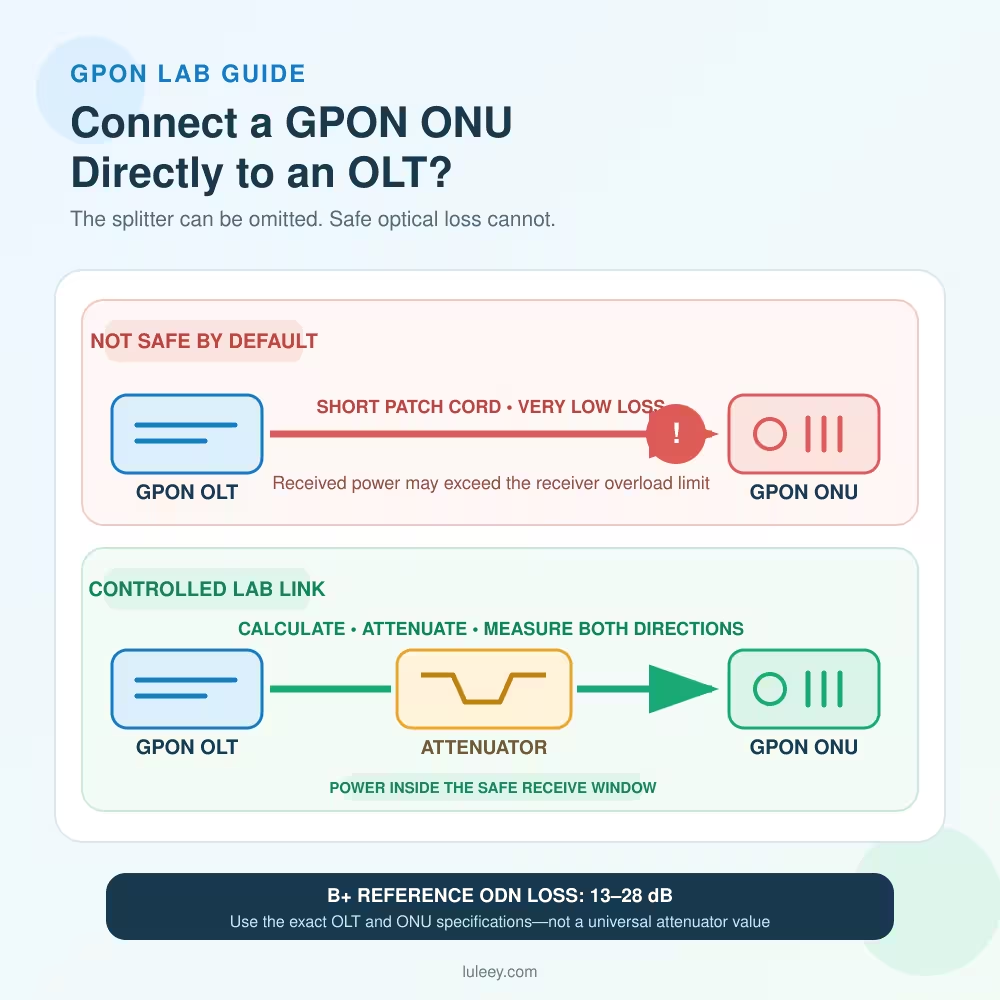
Never connect active OLT transmitters together using an unplanned passive coupler. Incorrect isolation or power levels can disrupt service or invalidate the optical design.
The Seven Checks Before Reusing an Existing Splitter
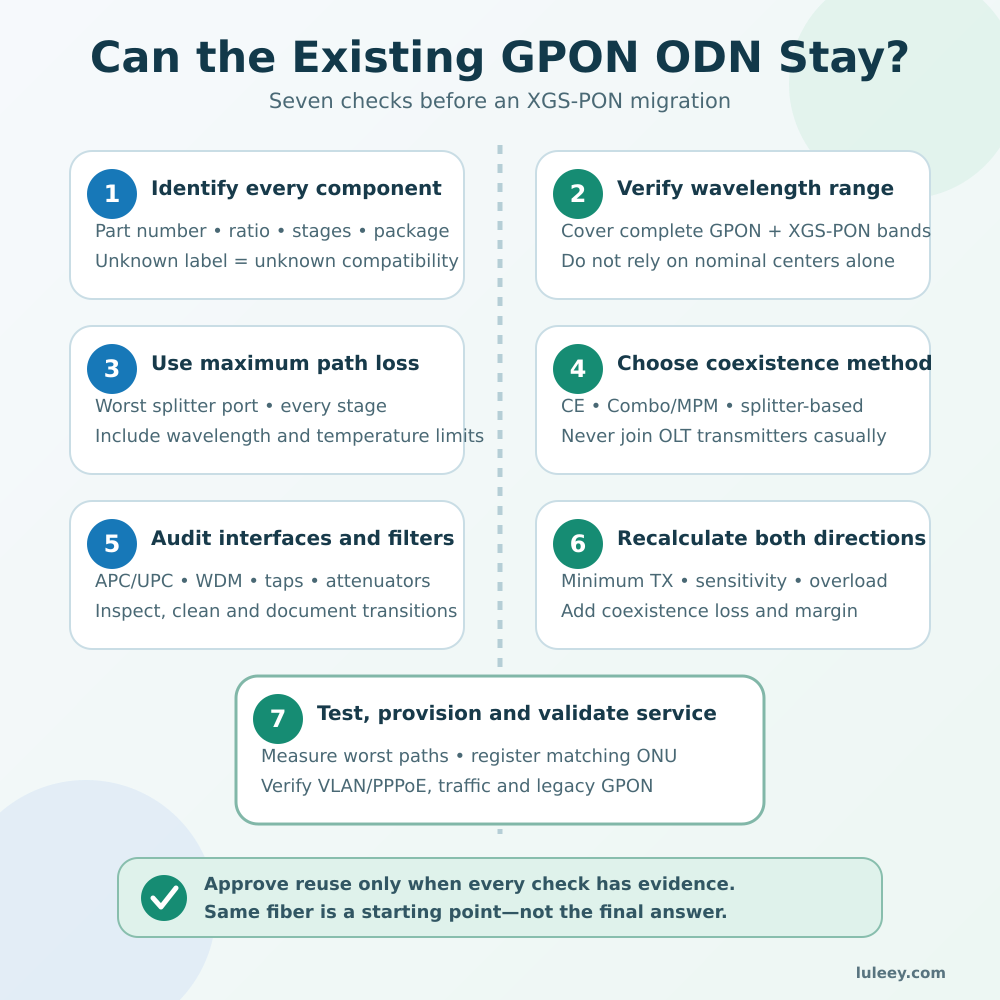
1. Identify the exact splitter
Record the manufacturer, part number, technology, package, ratio, connector type and installation date. If no records exist, do not replace missing evidence with a visual guess.
PLC splitters are commonly broadband. Some older FBT or wavelength-selective devices may be optimized for particular bands. Technology names are useful clues, but the finished product specification is what matters.
2. Verify the operating wavelength range
The documented range must cover the required GPON and XGS-PON bands, including upstream and downstream tolerances—not only the nominal values in a comparison table.
For example, LuLeey’s 1×8 SC/APC PLC splitter is specified for 1260–1650nm operation. That range covers the common GPON and XGS-PON wavelengths discussed here. This conclusion applies to this verified product, not every item marketed as a PON splitter.
3. Use maximum loss, not ideal mathematical loss
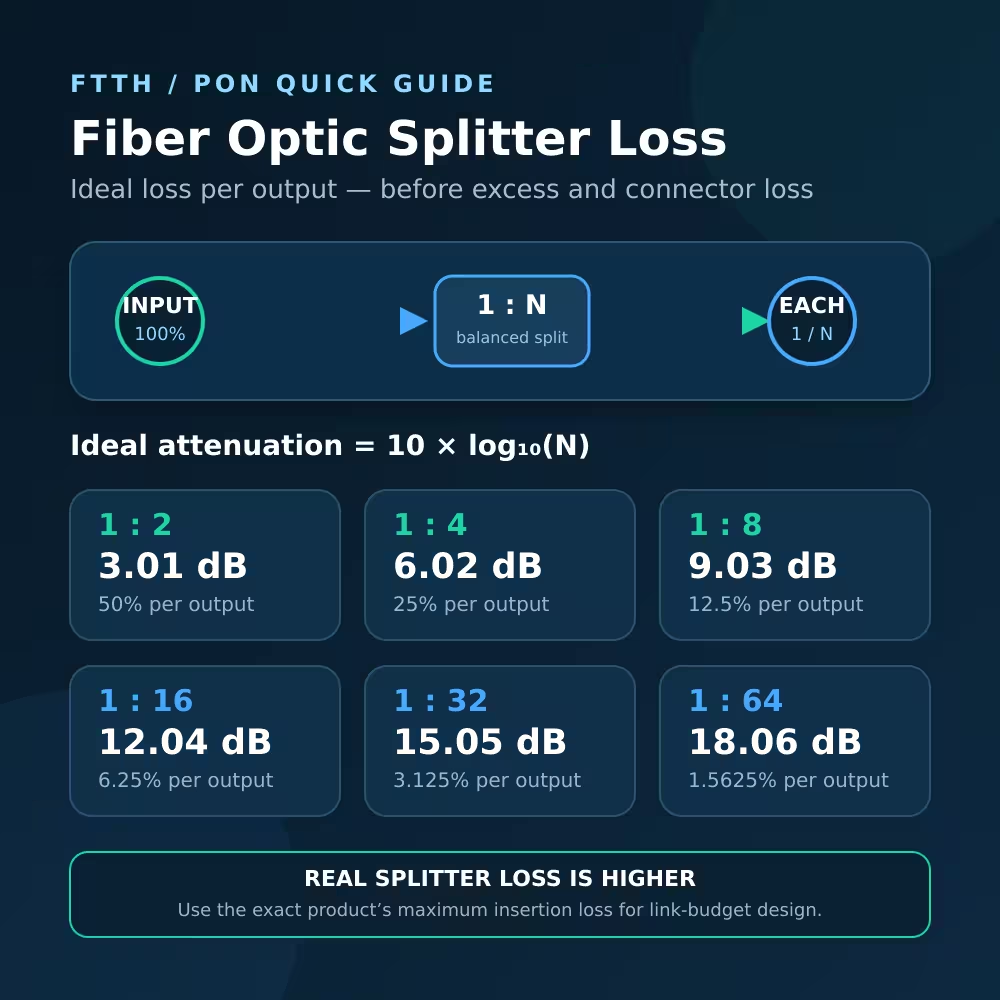
An ideal 1:8 division costs about 9.03dB. A real splitter has additional loss and port-to-port variation. The verified LuLeey 1×8 page lists maximum insertion loss of 10.7dB and loss uniformity of no more than 0.8dB.
Use the guaranteed maximum for the exact package and connector version. LuLeey’s fiber optic splitter loss guide explains why the number after 1: is not a dB value and why every cascaded stage must be counted.
4. Recalculate the complete Optical Budget
For each subscriber path, include:
- Maximum insertion loss of every splitter stage
- Fiber attenuation at the relevant wavelength
- Connector, adapter and splice allowances
- Coexistence element, WDM, monitoring tap or filter loss
- Repair and aging allowance
- Required engineering margin
Calculate downstream and upstream separately. Use the exact minimum transmitter power, receiver sensitivity and receiver overload limits for the selected OLT and ONU optical classes.
An existing GPON path with comfortable margin may remain suitable. A long, cascaded or heavily split route may fail the XGS-PON design even though its splitter passes the required wavelengths.
5. Audit every passive component
The route may also contain:
- RF-video filters or combiners
- CWDM/WDM components
- Optical taps and monitors
- Fixed attenuators
- Patch panels and adapters
- Unrecorded second-stage splitters
- Bend-sensitive drop cables
One narrow-band or high-loss component can invalidate an otherwise reusable ODN.
6. Match connector type and polish
SC/APC and SC/UPC use a similar connector family but different end-face geometry. Do not directly mate APC and UPC. Confirm every OLT, coexistence device, splitter lead, adapter, patch cord and ONU interface.
Connector color or body shape alone is not adequate acceptance evidence. Inspect and clean accessible interfaces before recording loss.
7. Test representative paths at the required wavelengths
Start with the highest-loss routes, weakest splitter outputs and longest branches. Use instruments and procedures suitable for the wavelength and for whether the PON is live or dark.
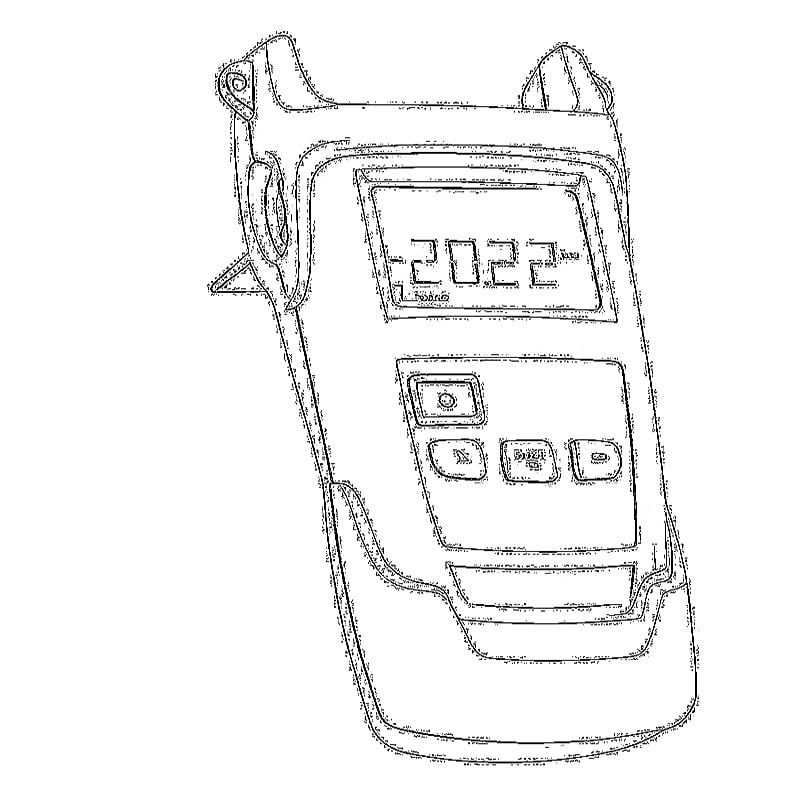
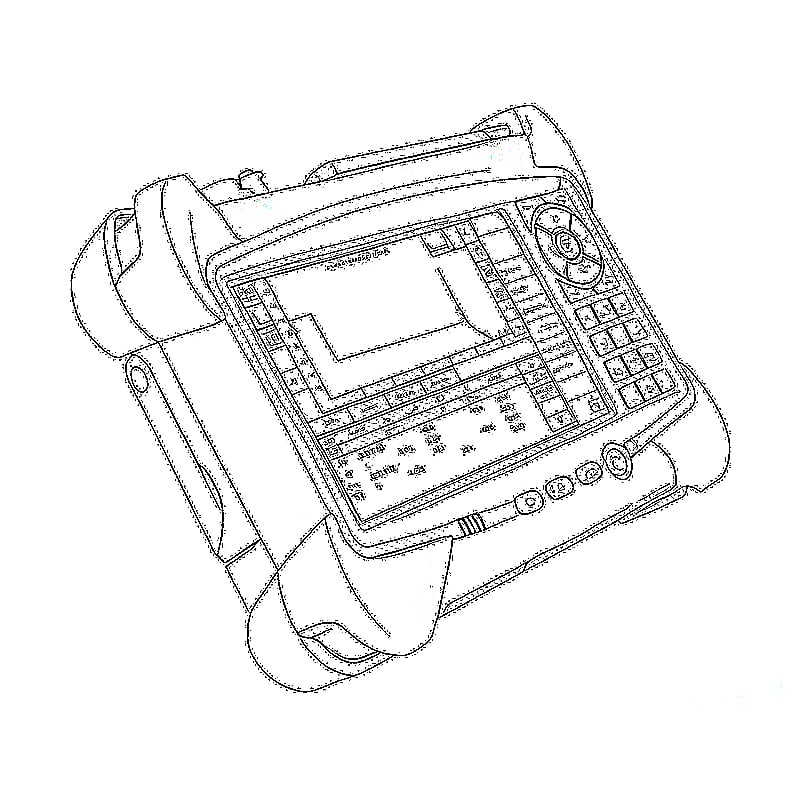
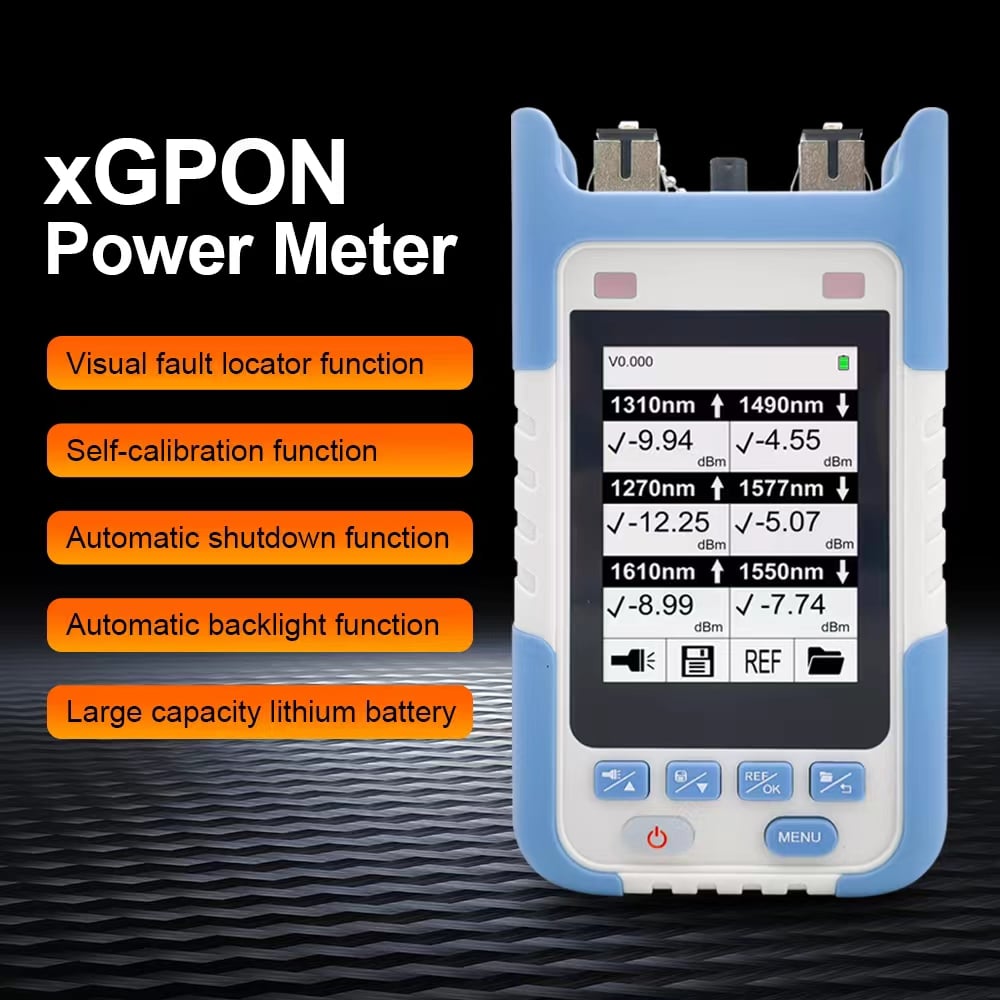
A basic power meter may show combined light without separating simultaneously active PON channels. For live coexistence measurements, use a wavelength-selective PON meter supporting the actual GPON and XGS-PON bands and upstream burst measurement when required.
Example: Rechecking a 1×8 Branch
Suppose an existing branch uses the verified LuLeey 1×8 PLC splitter described above.
The product evidence provides:
- Operating wavelength: 1260–1650nm
- Maximum insertion loss: 10.7dB
- Maximum loss uniformity: 0.8dB
- Connector: SC/APC
- Fiber: single-mode G.657A
The broad wavelength range supports considering the component for reuse. It does not complete the network design.
The engineer must still add feeder and drop-fiber loss, every connector and splice, any coexistence device, other splitter stages and the required margin. The result must be checked against the exact XGS-PON OLT and ONU specifications in both directions. The highest-loss output—not the easiest output to reach—should drive the worst-case review.
How to Upgrade Without Disconnecting Every GPON User
A phased migration normally follows this logic:
- Inventory the ODN and identify unknown passive components.
- Choose the approved coexistence or Combo PON architecture.
- Calculate worst-case GPON and XGS-PON budgets after adding new passive loss.
- Lab-test the exact OLT, optics, ONU and representative splitter path.
- Introduce XGS-PON on a controlled branch or subscriber.
- Provision a matching XGS-PON ONU using the operator’s authorized process.
- Verify optical power, registration, service VLANs and traffic.
- Monitor existing GPON subscribers for any change.
- Keep records and a tested rollback path before expanding the migration.
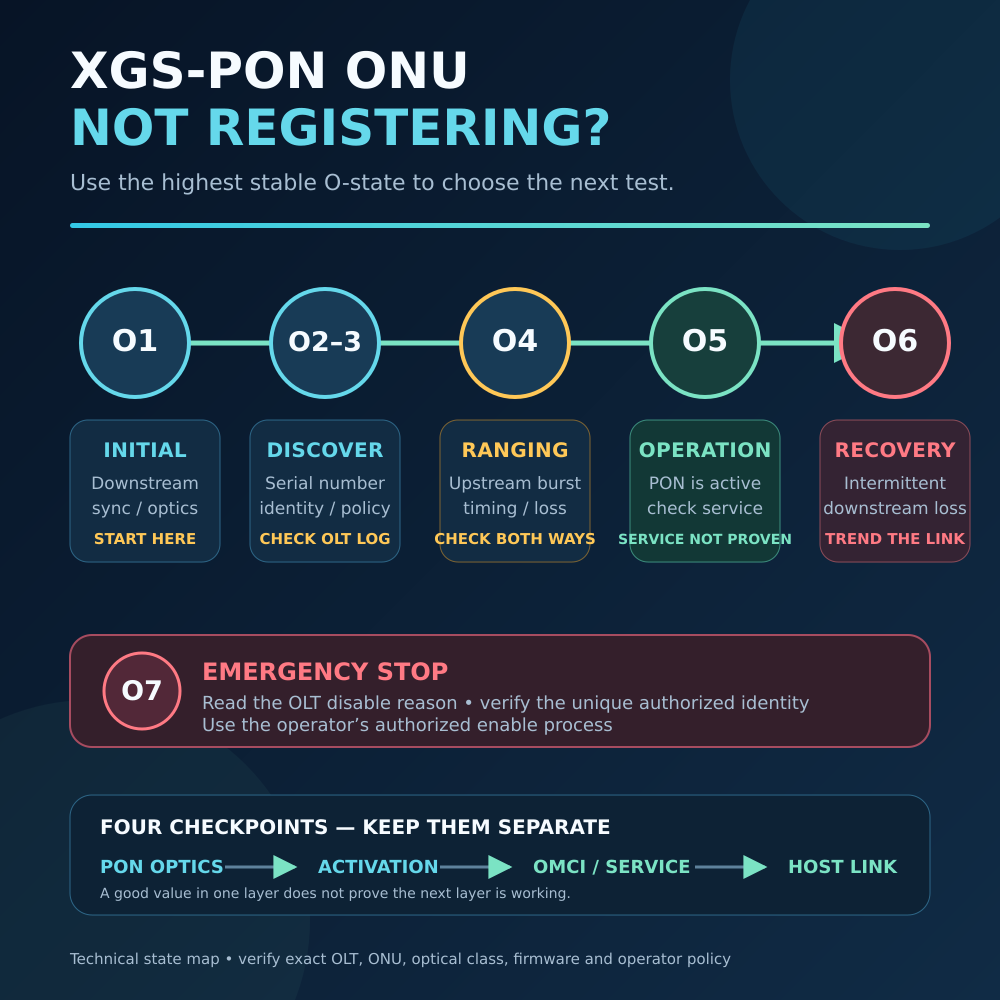
Do not assume optical registration proves the customer service is complete. PON activation, OMCI provisioning, VLAN mapping, DHCP or PPPoE and subscriber authorization are separate layers.
Special Case: Replacing a GPON ONU with an XGS-PON ONU Stick
Reusing the splitter does not make a GPON ONU suitable for XGS-PON. The customer-side device must match the network generation and provider provisioning.
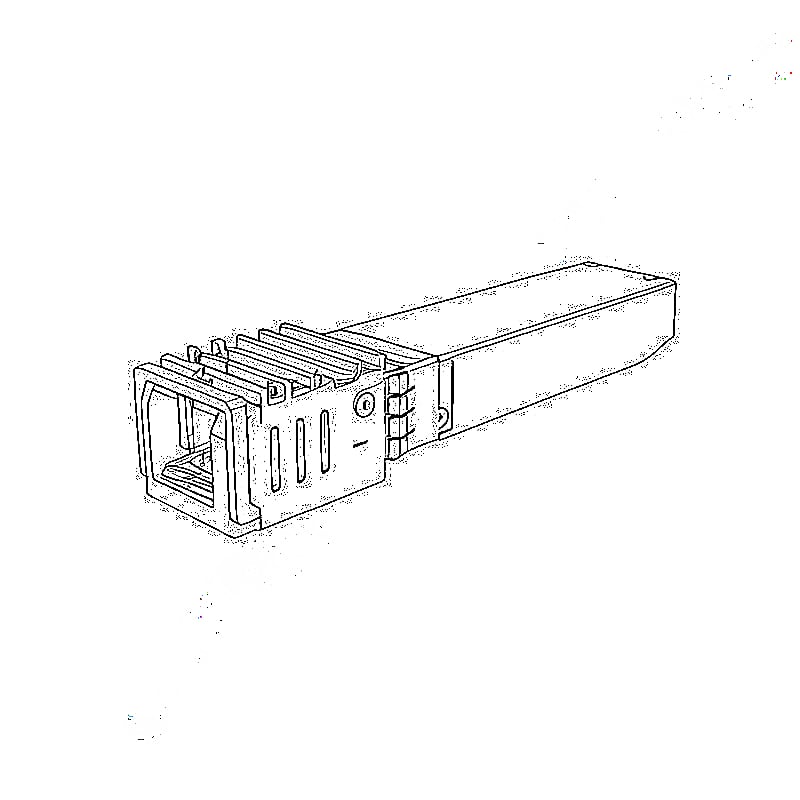
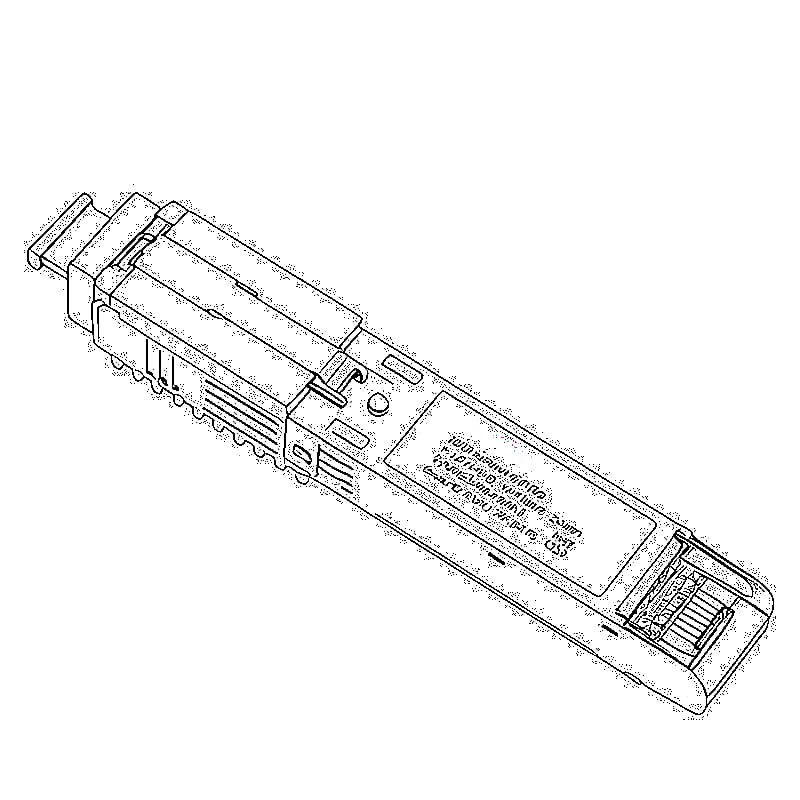
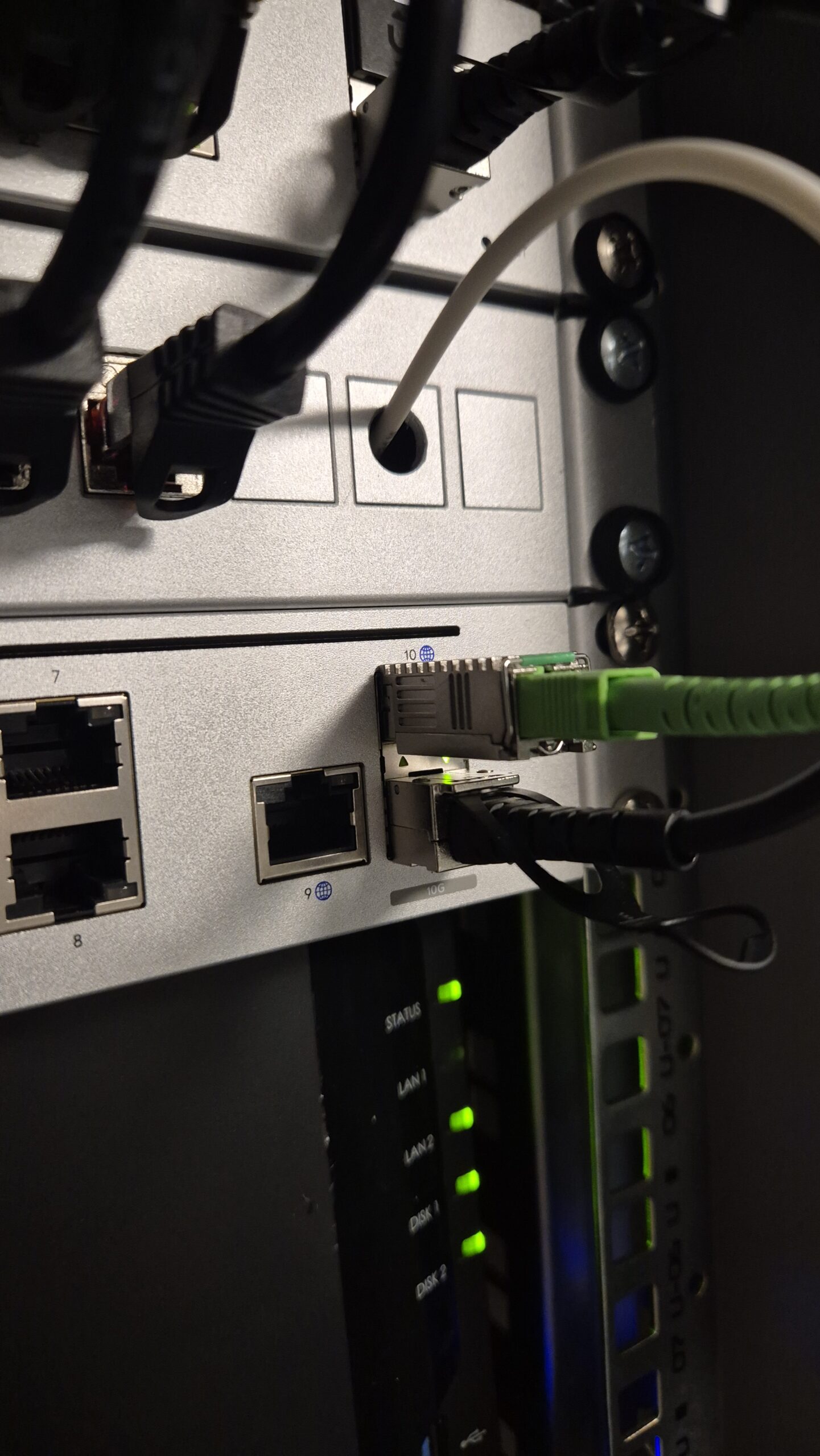
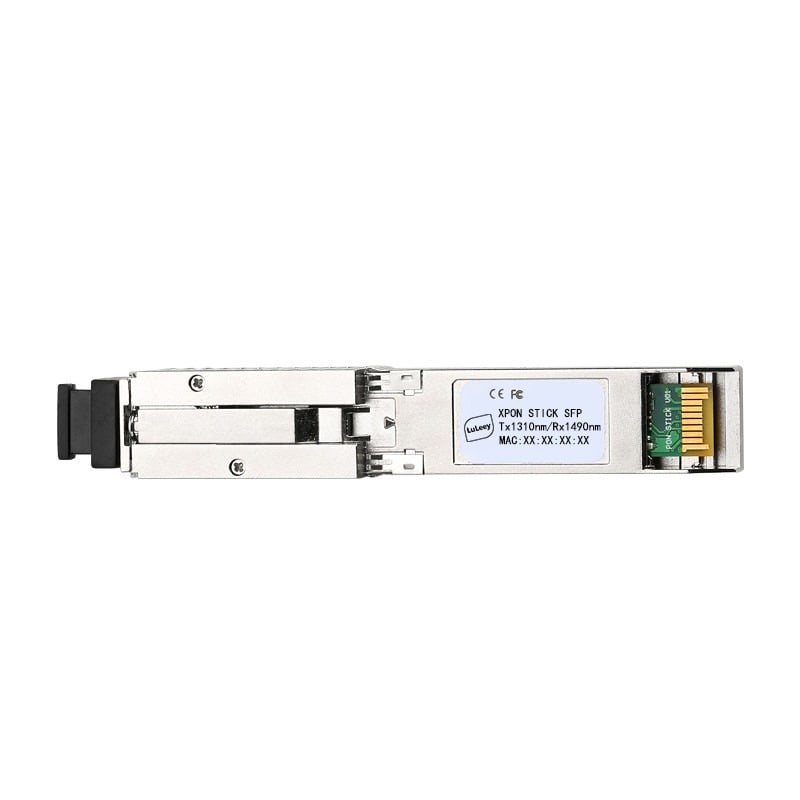
LuLeey’s LL-XS1010 XGS-PON ONU Stick is listed for XGS-PON/XG-PON, with 1270nm upstream transmission, 1577nm downstream reception, SC/APC or SC/UPC options and an SFP+ package.
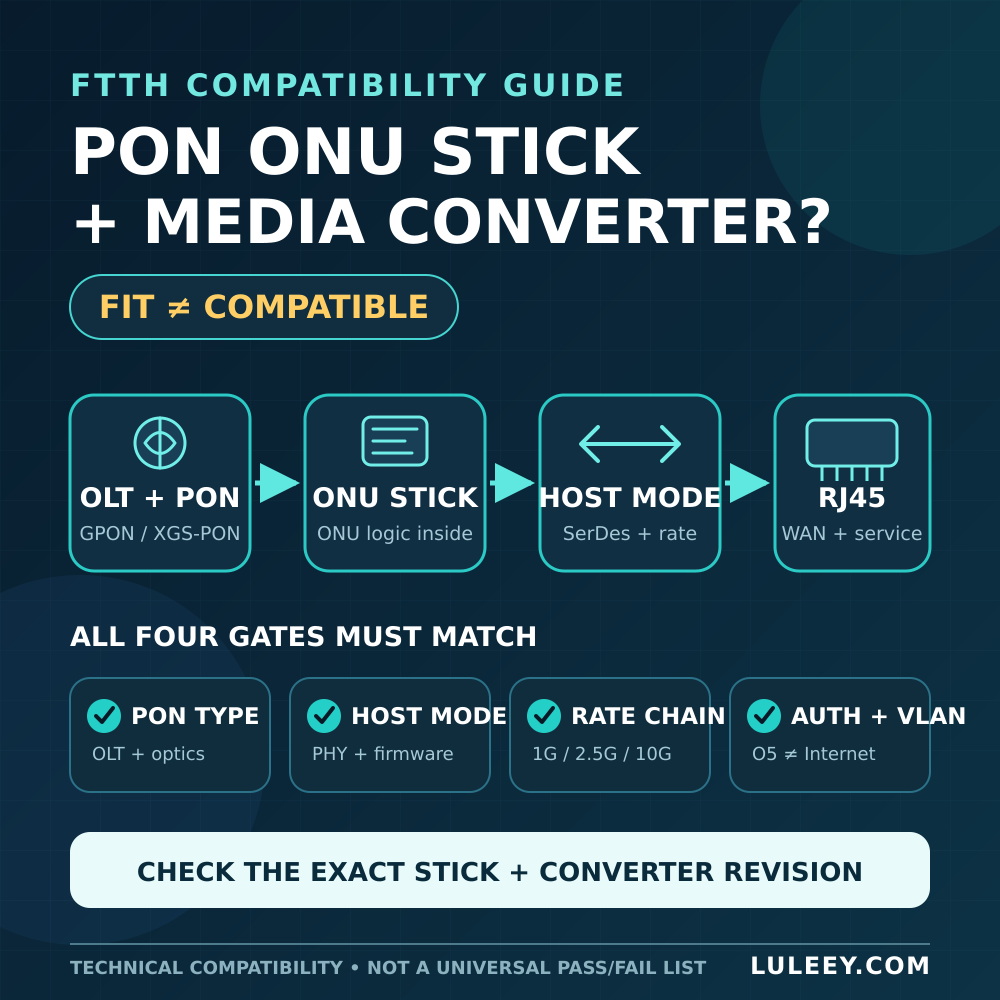
An SFP+ package is only the physical host form factor. Before using any ONU Stick, verify:
- Exact OLT PON generation and supported ONU profile
- Authorized serial number, vendor ID, LOID or other authentication fields
- OMCI behavior and firmware compatibility
- Connector polish and received optical power
- Host chipset or PHY and supported SerDes modes
- Stick host mode
- Host firmware and driver
- Port speed and power settings
- Module coding acceptance
- Actual negotiated host-side rate
- Maximum usable throughput
- VLAN, DHCP or PPPoE design
- Cooling and power availability
Do not infer 1G, 2.5G or 10G host compatibility from the words SFP or SFP+ alone. A lower negotiated host rate also limits usable throughput even when the PON side is registered.
Common Upgrade Mistakes
“The splitter is passive, so every wavelength will pass”
Passive does not mean wavelength-independent. Verify the specified operating band and maximum loss.
“XGS-PON is backward compatible with every GPON ONU”
ODN coexistence is not protocol interchangeability. A GPON ONU requires a GPON-capable channel.
“The old 1:64 worked, so the budget is fine”
The new optics, coexistence loss, wavelength-dependent fiber loss and engineering margin must be recalculated.
“A green SC connector means the whole route is correct”
Connector color is not a complete record. Confirm APC/UPC polish, adapter type, condition and every hidden transition.
“O5 or registered means the upgrade is finished”
Registration does not prove subscriber VLANs, Internet access, IPv6, voice, IPTV or expected throughput.
Final Answer
You can often reuse an existing GPON splitter during an XGS-PON upgrade when the exact splitter is specified across the required wavelength bands and the full route passes a new optical-budget review.
Do not approve reuse from the word “GPON” or from physical connector fit alone. Verify:
- Splitter wavelength range and maximum insertion loss
- Split ratio, cascaded stages and weakest output
- Coexistence element or Combo PON architecture
- Every passive component and connector transition
- Separate upstream and downstream optical budgets
- Correct GPON or XGS-PON ONU type and provisioning
- Live-network measurements and service validation
When requesting a migration or splitter recommendation from LuLeey, provide the current OLT and ONU models, splitter part numbers and stages, connector polish, route lengths, measured optical power, planned coexistence method, target split ratio and proposed XGS-PON optical class.

 SFP/SFP+ (1G/2.5G/5G/10G)
 SFP-T (1G/2.5G/10G)
 AOC Cable 10G/25G/40G/100G
 DAC Cable 10G/25G/40G/100G
 QSFP28 QSFP+ SFP28 100G/40G/25G
 Copper to Fiber Media Converters
 Fiber Media Converter PCBA Board
 OEO Fiber Media Converters
 Serial to Fiber Media Converters
 Video to Fiber Media Converters
 1000M GPON/EPON ONU
 10G EPON ONU/XG-PON/XGS-PON
 2.5G GPON/XPON STICK SFP ONU
 POE GPON/EPON ONU
 Wireless GPON/EPON ONT
 EPON OLT
 GPON OLT
 SFP PON Module
 Industrial Switches
 Managed Switches
 POE Switches
 Unmanaged Switches
 MTP/MPO Fiber Cables
 Fiber Optic Cassettes
 Fiber Optic Loopback
 Optic Cables and Fiber Pigtails
 Optical Splitters and Splitter Box
 Fiber Flange Connectors
 Optical Adapters
 Optical Attenuator
 Quick Connector and Connector Panel
 CATV Amplifier
 CATV Optical Receiver
 Visual Fault Locator
 OTDR
 Optical Power Meter
 Fiber Optic Identifier
 Fiber Optic Cleaners
 Fiber Cleavers & Fiber Strippers
 Copper Tools


